

by Christine Swan
I believe that everyone who begins investigating their family tree always hopes to discover something amazing – riches beyond their wildest dreams, links to royalty, heroic deeds or global fame. The reality is often that lives have been quietly led with humble means.
I certainly don’t believe that ordinary people are any less interesting or that their stories are not worth telling. I relish visiting the places where they lived, worked and worshipped, to sense the past and my connection to it.
“We’re descended from the Huguenots,” my father regularly asserted. After years of research and no credible connections found, I was ready to dismiss this as yet another family myth. The discovery of some silk weavers based in Bethnal Green, and later, some French surnames that had not been anglicised. I discovered that I had a number of ancestors living in Canterbury during the seventeenth and early eighteenth centuries who worshipped in the Walloon and Huguenot church, in French, retaining the native spelling of their names.
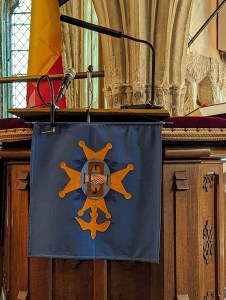
The symbol of the Huguenots
Last summer, I visited Canterbury to explore its silk weaving past and close association with new immigrants who had escaped persecution for their Protestant faith in their native France. I was fortunate enough to have the Huguenot chapel in the crypt of its famous cathedral. Originally, the smaller church of St Alphege was used but the huge number of immigrants required a larger venue. When I arrived at the cathedral, I was told that the chapel wasn’t open on the day of my visit but I think that the counter assistant took pity on me as I had travelled such a long way. A few minutes later, the key turned and I was standing in the chapel where many of my ancestors had stood, in that very spot. It made the hair on the back of my neck stand up. The connection with the past crackled and I felt very connected to the small community that made this place their home.

In the Huguenot chapel in Canterbury Cathedral
I also visited Rochester in the hope of visiting the Huguenot Museum. I think it is only my luck that caused my visit to coincide with the annual summer holiday that closes the museum. Hey hum, I will schedule a visit for another time.
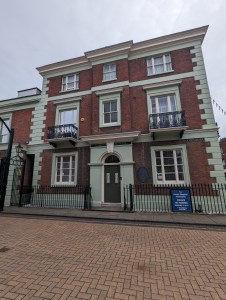
The French Hospital in Rochester
I have remarked to several people that visiting France and speaking French feel very natural and homely. Further research revealed family origins in the north of the country, some of whom emigrated to England as refugees. Some did not choose this route. Instead, they travelled East, through Belgium and into the Netherlands. The Huguenots came from France and the Walloons, from Belgium but both were protestant people, risking persecution by the predominant Catholics. When I first uncovered records of people born in regions of France, but living in Leiden, I assumed that this was an error on my part. Perhaps two different people, with the same name, born in the same year, with the same spouse – no? Surely not? The more I researched, the more it seemed that it was implausible that these were different people.
Ancestral records in the Netherlands are very detailed. For example, a marriage record will often reveal not only the names of the happy couple, their addresses, occupations and birthplace, but also parents’ names, possibly brothers and sisters, their addresses and the names of previous partners if they were widowed. This incredible level of detail provides twenty first century time travellers, a swirling, portal window to the past.
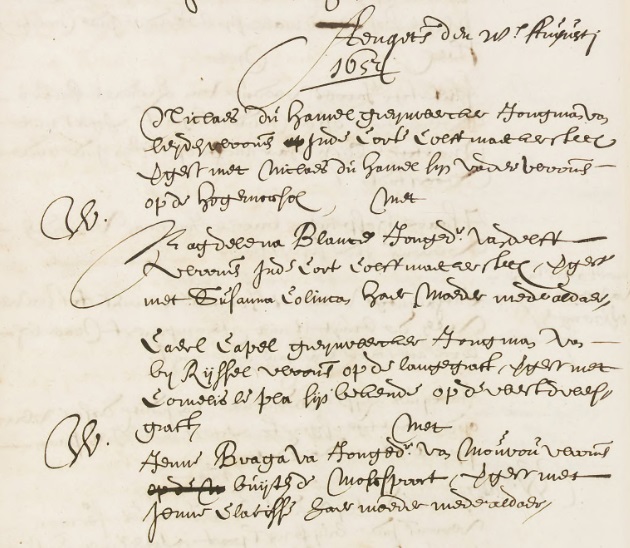
Nicholas du Hamel married Magdelena Blanchet in 1654
My ancestors settled in Leiden and worked as weavers. In the seventeenth century, the Netherlands was a world economic powerhouse and very wealthy nation. Leiden was also at the centre of one of the earliest examples of an economic speculation bubble in the form of “Tulip Mania”, where the humble but beautiful, garden bulb became prized above all other commodities. One single bulb could cost ten times the annual salary of a skilled worker. The du Hamels lived in Leiden through this temporary insanity, working as humble wool workers, playing their role in the production of famous Leiden cloth, which was widely prized and exported. Nicholas du Hamel worked as a wool comber, preparing the wool to be spun. Another family member was a saaiwerker which translates to “boring worker”. This particular gentleman is the only Dutch person that I have found, who married into the French Blanchet family. In fact, Cornelis was not at all a boring worker, instead he was a saewerker, working with raw, unprocessed wool. My DNA confirmed that I do indeed have Dutch genes and so the circle is complete. Unfortunately, cheap imports of woollen broadcloth, often from England, caused the decline of the value of Leiden cloth.
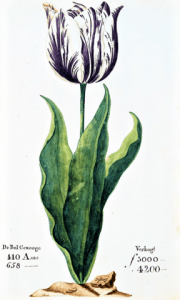
Tulip Mania began in Leiden. This is the Viceroy, as pictured in a 1637 plant catalogue By Unknown author – https://images.wur.nl/digital/collection/coll2/id/318, CC BY-SA 4.0, https://commons.wikimedia.org/w/index.php?curid=126785719
Judith du Hamel was the first emigrant of this particular family to travel to Canterbury. There she met and married Claude Gaffe, a Huguenot silk weaver. The Gaffes moved north to London, when silk weaving was in its ascendency, but this is another story for another time.
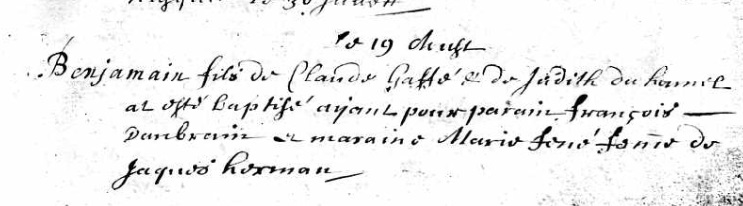
Benjamin Gaffe, son of Claude and Judith, was baptised in Canterbury in 1688
By some miracle, much of the medieval city of Leiden has survived and many street names have not changed, other than a few cases that I have found. One particular moment was when simultaneously reading a record from four hundred years ago and toggling between this and Google Maps, I discovered that one street name had only changed by a C having been replaced by a K. I felt quite emotional to see such a tiny change over such a long period.
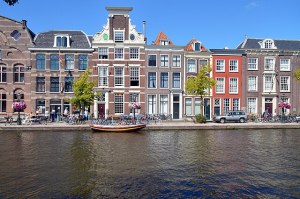
Historic Leiden – By Roger Veringmeier – Own work, CC BY 4.0, https://commons.wikimedia.org/w/index.php?curid=151291891
My mind was made up, I must visit this place. Next week, I will travel to Leiden to visit where my ancestors lived, worked and worshipped, to walk the same streets that they did, but with a K instead of a C, and to share some of the sights that they did, four hundred years ago. I will tell the stories of the individuals and families in as much detail as I am able.
More information
The Strangers in Canterbury – http://frenchchurchcanterbury.org.uk/history/strangers-in-canterbury.html
The Huguenot Museum, Rochester – https://huguenotmuseum.org/
The Huguenot Society – https://www.huguenotsociety.org.uk/history.html
Leiden history – https://www.visitleiden.nl/en/highlights/history
Leiden cloth – https://www.lakenhal.nl/en/story/leiden-cloth
 Awful Rigours and Wretched Pay
Leave a comment