
by Christine Swan
My great, great grandfather William Aylott, was born in Hoddesdon, Hertfordshire in 1825, the son of a lawyer, Thomas. In about 1830, the family moved to Stratford in East London where Thomas continued to practice. In the 1841 census, the family were living in Union Street. William was one of eight children, and contributed to the family income, aged fifteen years, as a delivery boy.
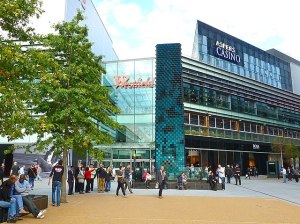
Stratford Westfield shopping centre – By HerryLawford – https://www.flickr.com/photos/herry/6153348496/in/photostream/, CC BY 2.0, https://commons.wikimedia.org/w/index.php?curid=16647988
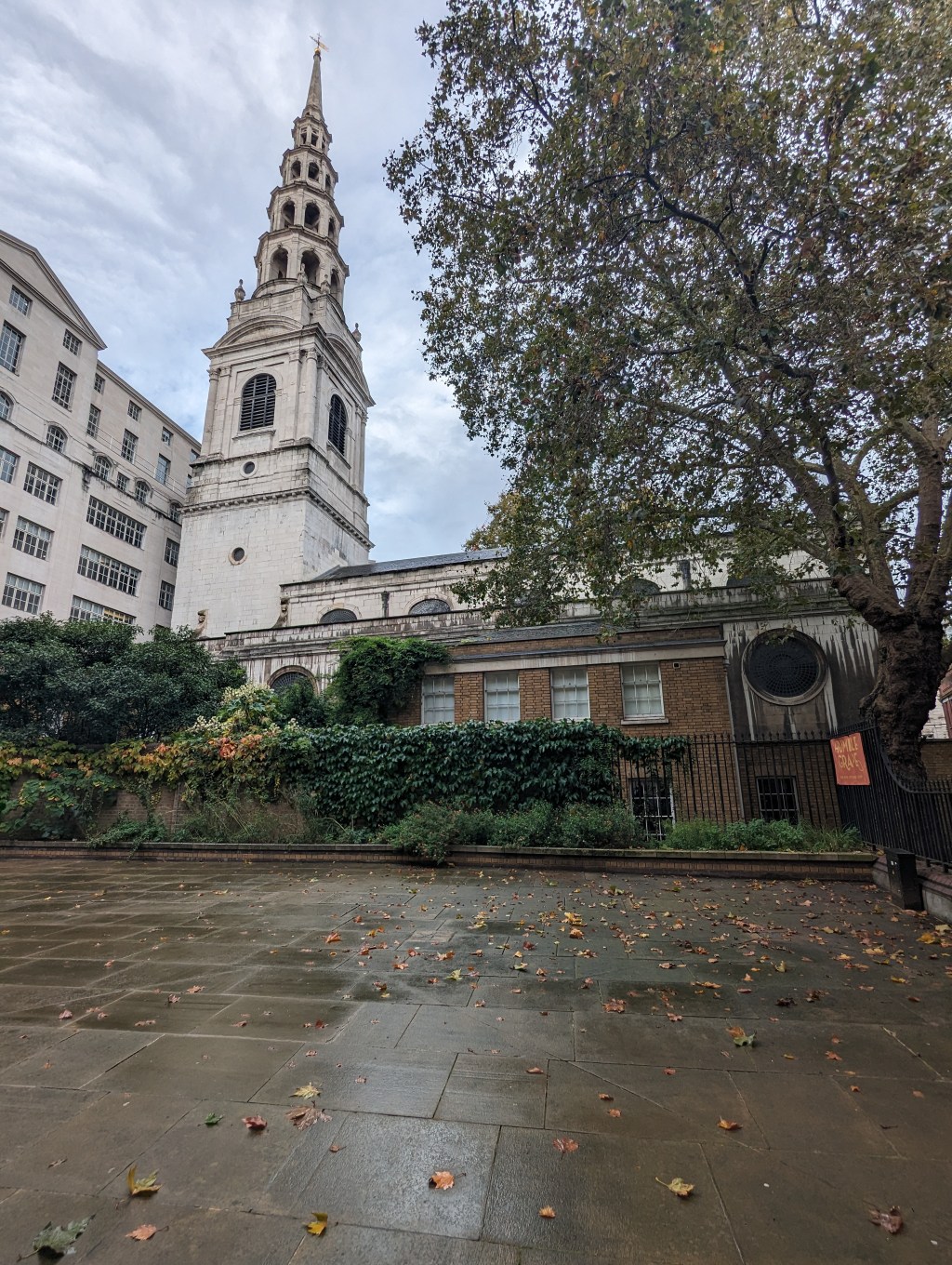
William married six years later on 4th July 1847 in the magnificent St Bride’s Church, Fleet Street. This seemed to be an odd choice of venue as he gave his address as Stratford, but Isabella Kemplay, his intended bride, gave hers as Bridge Street. I assume that this is what is now called New Bridge Street, Blackfriars which is very close by.

Inside St Bride’s church
So it was that the happy couple were wed in the magnificent surroundings of the original church. St Bride’s was massively damaged during a World War II bombing raid, so the roof and interior are relatively recent, dating from the nineteen fifties. At the altar end of the nave, there is now a spectacular trompe l’oeil mural which successfully tricks viewers into believing that the flat wall is in fact, curved. This impressive deception, is not the only feature worth visiting St Bride’s for. After the ruin of the bombing and subsequent fire, an entrance to the historic crypt was also discovered. This had been sealed as the church was used as a burial pit for victims of the plague. Sufficient centuries have elapsed to make it safe for modern visitors and it now houses the museum of the church and artefacts discovered from key periods in its history. Walking around the ancient crypt, I could imagine the original church, and as I stood in the modern aisle, tried to imagine young William and his new bride Isabella, standing there on their happy day.
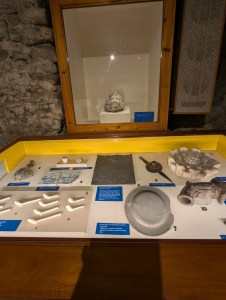
Museum artefacts in the crypt of St Bride’s church
Another William Aylott had a bookseller’s shop in Paternoster Row, just a short walk away. I have not yet established the relationship, if any, between this gentleman and my ancestor, but as a relatively uncommon surname, and the links with the church and the print and media world, suggest that there could indeed have been a relationship between them.

The ancient church crypt lies beneath
Baby Isabella, my great grandmother, was born in April 1848 and Thomas Aylott, William’s father, died just a year later. He was buried in All Saints Church, West Ham. The lawyer’s pen was passed to William to continue the profession. One fact has puzzled me, and it is this – on the marriage record of William’s sister, Hannah Ann, Thomas signed his name with an X. William did the same on his own marriage record, and yet, both claimed to be lawyers. How could it be that members of the legal profession were unable to sign their own names? This is a mystery to solve for another day.
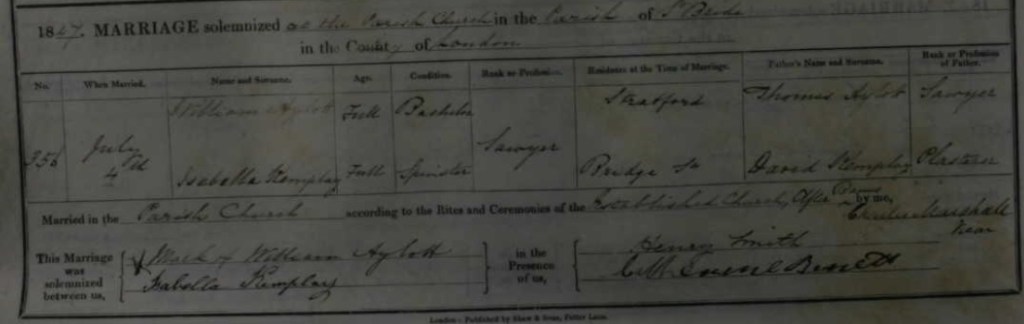
Why did William Aylott sign with an X?
In 1861, the family had moved from South Street to the intriguingly named Horsepond, near Laboratory Yard. Stratford hosted industries that would not have been permitted within the City of London, such as the manufacture of pharmaceuticals and other chemicals, soap works, candlemakers, tanners, dyers and weavers all were accommodated in the area, providing much needed employment for the population, and products for London and beyond. Laboratory Yard was one such industrialised area. The Horsepond was originally intended, as the name suggests, for the refreshment of animals, but was also used for human bathing and clothes washing. However, this particular one also had a tragic history including a suicide in 1859 and the horrific discovery of a drowned newborn baby in 1868. It was here that William lived, worked and raised his family.

The Aylotts living in Horsepond, Stratford
The area where the Aylotts lived is unrecognisable today. Extensive bomb damage from World War II, removal of old industrial buildings and slums, development of the London Olympic site have changed the area completely. Living so close to several rivers, with the City Mill River running almost by their front door, living at Horsepond would have been a hazardous place for young children. In the 1861 census, Isabella had been joined by Eliza Ann, William junior and George James.

City Mill River , Stratford – this would have run past the Aylott’s front door
The family moved to nearby Warton Road and then Carpenters Road, which runs along the back of the Olympic Aquatic Centre. Son John was born in 1862 and Arthur in 1863.
William Aylott’s fortunes appeared to have undergone a change during this time. By 1971, he was no longer working as a lawyer but is recorded as working as a labourer in a local jute works. What caused this change of profession, I have no way of deducing. Eliza Ann was working as a machinist, William and George James were working as match fillers, aged just fifteen and thirteen respectively. The Ritchie jute works in Carpenters Road, occupied a large site and employed over one thousand people, mostly women and girls. It does seem an unusual occupation for WIlliam. Perhaps his health was failing and working as a lawyer was no longer possible? Maybe a challenge to his practice, or a misdemeanor prevented him from continuing to practice?
Match making was also an occupation of the poor and associated with debilitating disease due to exposure to phosphorus such as bone damage known as phossy jaw. Most often cited is the famous Bryant and May factory in Bow, however there were other factories in East London including in West Ham. A number of role could be performed at home so were often carried out by women and children. Therefore it is not surprising that William and George James found employment in this industry, despite the risks.

Jute workers and match fillers in 1871
William died in 1874 aged just forty-nine. His wife Isabella survived him by two years. The children remained close, and after their parents had died, the younger went to lodge with their older, married siblings but all remained in the locality. My great grandmother, William’s eldest daughter, had married the year before he died and was living in the same road as family members. Brothers and sisters lived in nearby streets. There are still Aylotts living in East London. Although Stratford itself has changed and been reinvented as the famous site of the 2012 Olympic games, the family story continues.

 Awful Rigours and Wretched Pay
Leave a comment