
by Christine Swan
Just in case you were unaware, last weekend, this week and coming weekend, are a celebration of the built environment in London, organised by Open City. All relevant links are below if you are interested in a trip this weekend, the 21st and 22nd September.
I was very excited to travel to London last weekend and had spent some time building an ambitious itinerary for Saturday and part of Sunday. My first stop was to the Temple Bar in Paternoster Square, just a short walk from my hotel. The sun was bright and a queue had already formed. There is a camaraderie amongst “Open Housers” and it wasn’t long before I was chatting to a lovely lady and her daughter who also had a busy day planned. We shuffled forward to the bag check area and then ascended the stairs to a small conference room. Our hosts gave a very interesting presentation of the complex history of Temple Bar, one of the last remaining fragments of London’s gated past. As the crossing point between Westminster and the City, it would have housed guards, checking the credentials of travellers between West to East, or vice versa.

Temple Bar seen from the St Pauls side
The current position is not the original and the building had previously stood in Fleet Street and been an impressive gate to a stately home owned by a wealthy brewing company. When it fell into a state of sad disrepair, it was gifted and moved to its present location. Standing now in a state of compression, as was originally intended, it is a fine position, providing a vista of St Paul’s Cathedral on one side, and Paternoster Square on the other.

An lead medallion struck from the original roofing material showing the Temple Bar’s original gates
After our introductory talk, we were invited into the room above the gate. We were told that although it would originally have housed guards, it later became a store room for a bank for past ledgers. These eventually became such a burdensome weight that they threatened to damage the building. During its original use, the roof would have been decorated with the heads of significant criminals, treason-plotters and dissenters, as a warning to passing traffic – take heed, or this could be your fate! Apparently, when one head fell into the street below, it was quickly replaced.
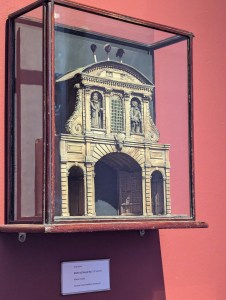
A model of Temple Bar, with gruesome decoration, hosed in the room above the gate
Temple Bar is now a function and conference venue but also an educational space , informing children of London’s rich, but sometimes grisly past.

The original site of Temple Bar in Fleet Street, close to the Royal Courts of Justice
My travels then took me to Fleet Street to visit the impressive church of St Bride’s, often associated with journalists, publishing and the media. A guide welcomed me and pointed out key highlights, one of which is the incredible trompe l’oeil mural behind the altar, that gives the impression of a curved wall when, in reality, the wall is flat. St Bride’s was devastated by a bomb during WWII, which destroyed the roof and large parts of the building. Thus, much of what we see today, was constructed during its renovation and repair during the 1950s.

Inside St Bride’s
One part that was unaltered was the historic crypt, which was open during my visit. Descending the steps leads to a journey through time, to London’s Roman remains and its past plague. The crypt had been sealed hundreds of years ago to prevent the spread of disease but was eventually reopened, and includes a display of exhibits uncovered. These record the history of the church and the surrounding area. A walkway takes you along the original church wall and ancient tombs.

Walking through time in the crypt of St Bride’s
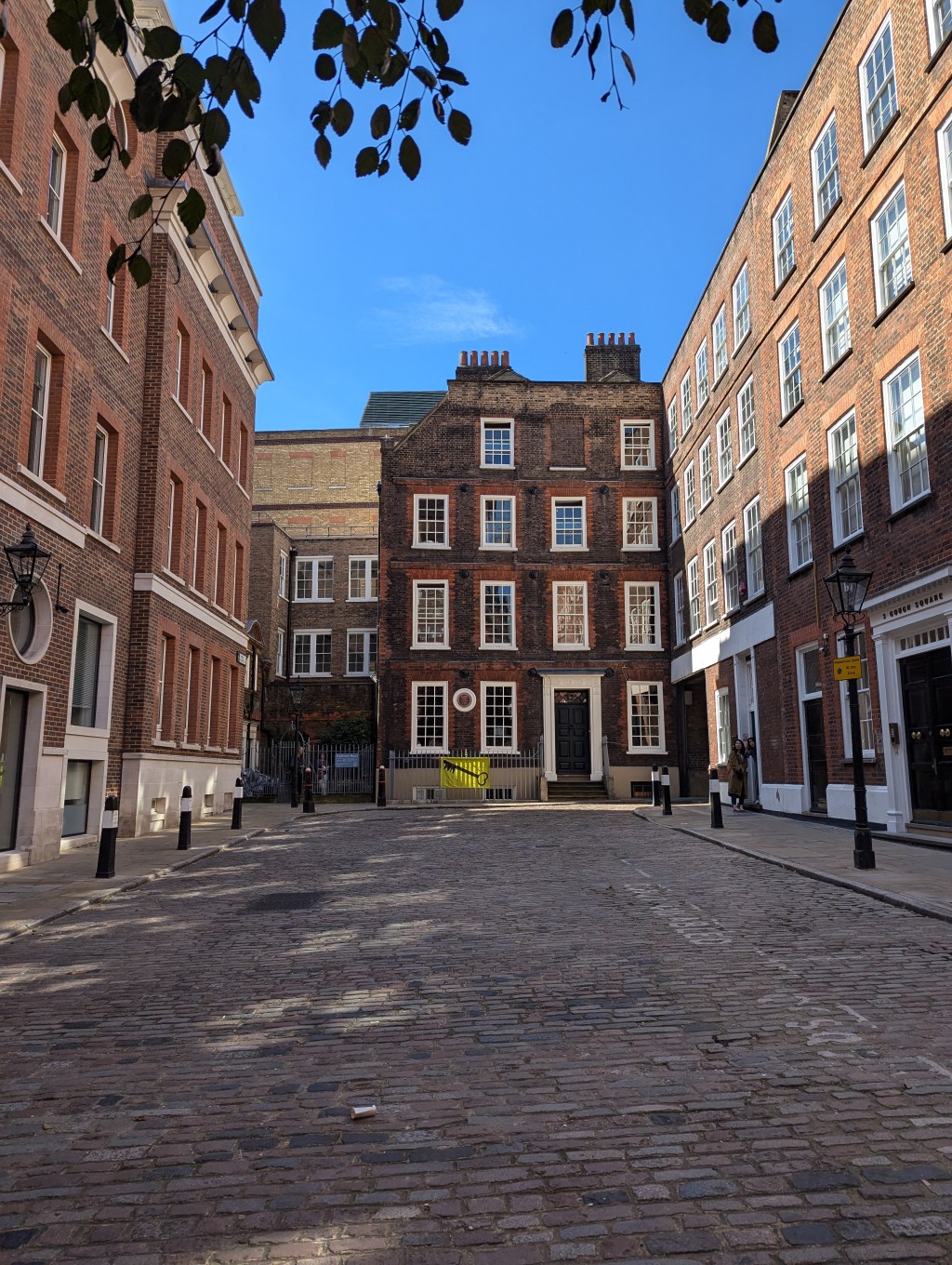
After a few twists and turns, I navigated to Gough Square to visit Dr Johnson’s House. I try not to have favourites, but this was the highlight of my Saturday tour. It felt like a happy, family home. Of course, I could be completely mistaken but, we know that it was also inhabited by a very fine cat, Hodge, who stands in permanence, staring at his former home.

Hodge, with a few oysters, forever looking at Dr Johnson’s House
The day was sunny and warm and I do feel that this contributed to my mood, but I did enjoy this visit, Small cards, with quotes, and interesting insights into the lives of the Johnsons, made me feel at home. I was particularly impressed with the moving wooden partition walls in an upstairs floor, that could ingeniously divide a large room into smaller ones, which were cosier and more protected from cold draughts wooshing up the stairs in cold weather.

A cosy downstairs parlour in Dr Johnson’s House

An ingenious wooden room divider to create cosy, smaller spaces out of one large room
My favourite room in this favoured building, was Dr Johnson’s writing garret. Dear reader if you imagine that I write this blog cosied up in my own dedicated space, you are mistaken. I am seated on my sofa, with a cat sleeping either side of me. Oh, how I need a writing garret!

Inside Dr Johnson’s writing garret

…..and a good garret!
Next stop was the Horse Hospital in Bloomsbury. This was quite a trek and the afternoon had grown warm in the sunshine. It was considerably cooler in the shade and drinkers were enjoying the late summer weather in the mews pubs in the Colonnade. The Horse Hospital is not a museum. It is an exhibition space downstairs, and theatrical wardrobe upstairs. The host explained that it had indeed been an equine hospital, unusually, with stabling on two floors, with ridged ramps between the two. Unfortunately, such prime real estate in such a favoured location, has led to huge rent hikes. The Horse Hospital needs your support if it is to continue as an arts space – the link is included below. After reminiscing of my time studying on the Kings Road, and moving among the fashionistas and stylistas navigating the post-punk world, of aspiring to be a new romantic whilst dwelling in old, unromantic student digs in Tooting, I travelled on.

Light installation in the old Horse Hospital exhibition space
It was now late afternoon and my water bottle was almost depleted. My final stop in this part of London was St George’s church in Bloomsbury. I have visited and written about this church previously, whilst researching the Apthorp family. When I arrived, the doors were wide open in welcome and I saw a sign which read: “Tea and cake this way”. This was my Wonderland, and I only needed to be reminded once to “Eat me” and “Drink me”. However, I hesitated when I realised that I had disposed of all of my cash, apart from a few coins, as donations at other venues. “It’s OK, we take a card,” came the cheery response from the lady from the West End Women’s Institute. For an exceedingly fair price, I was wonderfully refreshed.

A welcome sight indeed – St George’s church also participated in the Open House Festival
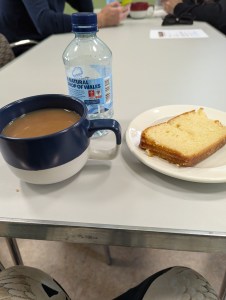
Nothing beats a cup of tea and lemon drizzle cake!
This is a church that I have visited previously so am familiar with its memorials and features. As is my custom, I always give a donation and light a candle for my dear late daughter, and I did so on this occasion. This church features prominently in one branch of my family tree and I imagined my great, great grandparents standing alongside me as the candle burned. I could feel hot tears spring to my eyes but I swallowed them back down. Grief has a wicked habit of coming up and tapping you on the shoulder, as if to say: “I’m not done with YOU yet!” In truth, it is never really done with us, is it?
“Are you OK? Do you need any help?”, said the voice behind me. I turned and saw that it was one of the hosts. I explained that I was looking for a donation box for the candle, as I had scrabbled together a few pounds in coins. The host smiled and pointed out the donation point near the font. “I have a lot of family history associated with this church”, I disclosed, and explained that I also did with St Giles in the Fields, just a short distance away. In contemplation, I thanked the host and stepped out into the setting sun.
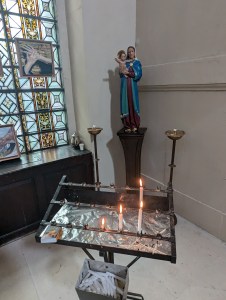
A moment of quiet contemplation

The lion forever chasing the unicorn around Nicholas Hawkesmoor’s final church
I shall write about my Sunday visits next week but if you can take part in this year’s Open House Festival, it continues this weekend, 21st and 22nd September. If not, I heartily commend it to you for 2025 and also the fine work of Open City in promoting London’s great architecture.
Further information
The Open House Festival 2024 – https://programme.openhouse.org.uk/
Open City – https://open-city.org.uk/
Temple Bar – https://www.thetemplebar.info/
St Bride’s church history – https://www.stbrides.com/about-us/our-history/
Dr Johnson’s House – https://www.drjohnsonshouse.org/
The Horse Hospital – https://www.thehorsehospital.com/about
St George’s church history – https://www.stgeorgesbloomsbury.org.uk/about-us
All photographs by the author
 Awful Rigours and Wretched Pay
Leave a comment