

by Christine Swan
Mary Flood was born in Borough, Southwark in 1806 and baptised at St George the Martyr church in 1808. The family lived in Queen Street which was located within an area with a fascinating history known as the Liberty of the Mint. Henry VIII established a supplementary mint in this area in about 1543. This being a Mint, it was given a degree of self-governance, immunities and liberties – hence the Liberty of the Mint was born. Debtors could reside within its streets, without risk of pursual within them, but to leave was risky. Residents defended their territory and repelled incursions by debt-collectors or press-gangs. The majority of residents were debtors but those with more violent criminal leanings would have received a less welcome embrace. Jack Shepherd and Jonathan Wild kept the horses that they used when committing highway robbery, in Redcross Street, within the protection of the Mint. The protection lasted up until 1723, when a special act removed these legal protections. However, there was also an amnesty for minor debts of less than fifty pounds.

The Mint, Southwark By This file is from the Mechanical Curator collection, a set of over 1 million images scanned from out-of-copyright books and released to Flickr Commons by the British Library.View image on FlickrView all images from bookView catalogue entry for book., Public Domain, https://commons.wikimedia.org/w/index.php?curid=32463560
Outside of the Mint was the infamous Marshalsea debtors’ prison, where the father of one Charles Dickens was sent. The Dickens were living in Lant Street in 1820 so Mary’s and his family, would almost have been neighbours. The area remained poor and this was to have a profound effect on Dickens who later referred to the Marshalsea as central to the plot of Little Dorrit. There are numerous name checks for Dickens’ characters in modern streets: Little Dorrit Court and Park, Quilp Street, Dickens Fields, and Copperfield Street. It wasn’t until 1888 that slum clearance started and new philanthropic social housing was developed, some of which can still be seen today.
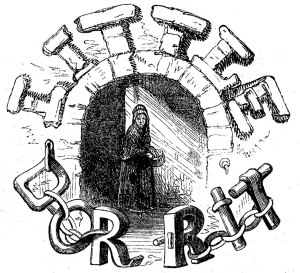
Little Dorrit by Charles Dickens – By Harper & Brothers (publisher) – “Harper’s New Monthly Magazine” Vol. XII, No. LXIX, February, 1856, New York: Harper & Brothers (Publisher)”The Cooper Collections ” (uploader’s private collection)Digitized by Centpacrr, Public Domain, https://commons.wikimedia.org/w/index.php?curid=27526958
Mary’s parents, Daniel and Susannah, were both born in the same year, but died within a month of one another, in 1833. I had very little information about the Flood family other than that Mary’s parents were married in 1799 in St George’s Hanover Square and that the witnesses were a Richard and Molly Flood. I also discovered a Richard Flood living in Queen Street, Mint, in 1811, just a few doors down from Daniel. This must be a brother, surely?

Mary Flood baptism , St George the Martyr, Southwark, 1808
The Flood family originally hailed from Honiton, Devon, and I have found hat makers in the family there as well as those who migrated to London. One interesting discovery was that two of Richard Flood’s children had Lott as a middle name. A quick search revealed that Messrs Flood and Lott opened the Honiton Bank in 1786 but this failed in 1847 causing massive losses to both families and resulting in bankruptcy. These dates straddle the period of my interest in this post. Brothers Daniel and Richard Flood would have left Honiton before the financial crash, and were both long dead before it happened. I doubt that they ever profited from it during its heyday. Theirs were meaner occupations, in the poorer part of town.
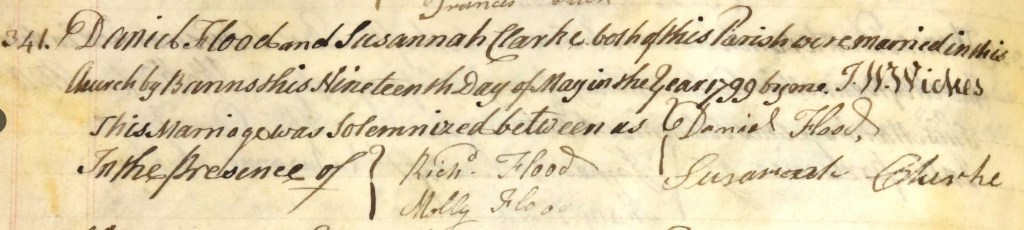
Marriage of Daniel Flood and Susannah Clarke with Richard and Molly Flood as witnesses
Mary was a middle child of Daniel and Susannah Flood and born within the Liberty of the Mint. Tragically only half of their children survived to adulthood. At this time infant mortality was over thirty percent nationally and, in London, nearer forty. Disease and poverty both took their toll, and in the poorest areas, most families would have been affected.

The interior of St George Hanover Square, where Mary Flood married William Henry Apthorp
Mary married William Henry Apthorp in 1825, in the same church where her parents had married twenty six years earlier. I am still not quite sure how the Apthorp family ended up at that end of Oxford Street but it seems even more bizarre that Mary was there. This is a mystery that is near impossible to solve as it predates census records, so my evidence relies on parish, land tax records and my very vivid imagination. Mary, William Henry and the little Apthorps, lived around the Bloomsbury St George and St Giles are before moving to Lambeth.

Mary, William Henry and the children in St Giles in the Fields in 1861. Son James is working as a hatter, which was his grandfather’s trade.
As documented previously in William Henry Apthorp’s blog post, the couple had three daughters and six sons. The family remained living around the St Giles in the Fields area but later moved to Lambeth. The Apthorps’ youngest daughter, Harriet Alice, married Charles Lewis, an Essex carman, in 1859. They lived in Clerkenwell and appeared to be childless. After the death of her husband in 1872, Mary went to live with Harriet and Charles in John Street, Clerkenwell. She remained living with them until 1888 when she was admitted to the City Road workhouse and later admitted a second time, where she remained until her death in 1890, aged eighty-four. This was indeed a great age when average life expectancy was about forty-eight years for women (in 1900).

Through writing about my forebears I feel that I get to know them better. In my journey, I try to find out as much as I can about their life. it is sometimes harder to research women because tax records and occupations are provided for males only. The Apthorp family appear to have led quiet lives and not attracted any scandal. They worked hard and generally avoided the workhouse, except towards the ends of their lives. Whilst they certainly were not rich, they survived, even living in areas that were notoriously poor.
Additionally, I find that I am looking at London through a new pair of eyes. Although the rookeries are long gone and areas that were desperately poor, are now the haunt of bright young things and are unrecognisable. I frequently visit the Southwark Playhouse theatre and walk past St George the Martyr church, which stands near a busy junction. The Mint and the Marshalsea have also gone, with only one wall of the latter remaining.
All original photographs by the author.
 Awful Rigours and Wretched Pay
Leave a comment