

By Christine Swan
William Henry Apthorp was born in 1803 in Bloomsbury, London and was my great, great grandfather. His father, Henry Welch Apthorpe had made the move from St Ives, Cambridgeshire, to London in about 1784, two years after the death of his father, my four times great grandfather. Henry Welch had been apprenticed as a butcher and St Ives was one of the areas used to fatten cows to be driven to the famous London market of Smithfield to be slaughtered. Smithfield was the centre of the meat trade in London and to be a merchant there would have been a far more profitable business than farming, so, Henry Welch sold his father’s properties, which included a pub and a slaughter house, as well as various dwellings, including one occupied by his widowed mother.

Old Smithfield seen in 1855 – By The original uploader was Honbicot at English Wikipedia. – http://www.philological.bham.ac.uk/hosp/market.gif, Public Domain, https://commons.wikimedia.org/w/index.php?curid=4177628
Henry Welch married in 1796 and first son Henry was born a year later. Sadly, he died when he was just eleven months old. A daughter, Fanny, was born in 1799 and William Henry, my great, great grandfather, was born in 1803. The family moved a short distance around Smithfield from Cow Lane, to Cow Cross – a road that still exists today. Henry Welch sadly died just four years later, aged just thirty four years. He was buried in St Sepulchre without Newgate, where his children had been baptised and he had married just eleven years earlier.

Cowcross Street looking towards Smithfield
William Henry Apthorp did not enter the butchery trade by following in his father’s footsteps, instead, he trained as a coach smith and wheelwright. In the process, he moved to the centre of the carriage making trade – Covent Garden and Bloomsbury. He married Mary Flood in 1825 in the magnificent church of St George’s in Hanover Square. I discovered that the famous female mathematician and programmer, Ada Lovelace, had been baptised there only ten years previously and Handel had been a regular parishioner during the 1700s. In this auspicious setting William was married.

The imposing exterior of St George Hanover Square

The equally impressive interior, where William Henry Apthorp and Mary Flood were married
I visited St George’s Hanover Square a couple of years ago and was struck by the hidden beauty of this church on the edge of Mayfair, just a short walk from Regent Street. The massive portico and opulent interior would have been at odds with William Henry’s very ordinary occupation and humble means. On the opposite side of the road is a traditional outfitters housed in a bow-front windowed shop. In this part of London, time appears to have partially frozen and only the roar of the traffic pulls you back into the twenty first century.

Time stands still opposite St George Hanover Square. This gentlemans’ outfitters would have existed when William Henry and Mary were married
The Apthorps’ first son, also William Henry, was born in 1826. He was baptised at the equally impressive St George’s Bloomsbury. Comparing the two churches at either end of Oxford Street, there are similarities and differences. Both were built under the 1711 Act that planned for the delivery of fifty new churches for the capital under a commission overseen by Sir Christopher Wren. The architect of Hanover Square was John James while that of Bloomsbury was Nicholas Hawksmoor, and was the last that he completed. His was one of a few designs proposed by other architects but only Hawksmoor’s vision was realised.

St George’s Bloomsbury – Nicholas Hawkesmoor’s final church
I visited St George’s Bloomsbury one chilly but sunny Sunday morning, just at the end of a service. The air was thick with incense which created clouds within the huge expanse of its interior. The low sun streamed through the open door which created dazzling brilliance, it was an impressive sight indeed. In front of me was the font where William Henry was baptised in 1826.
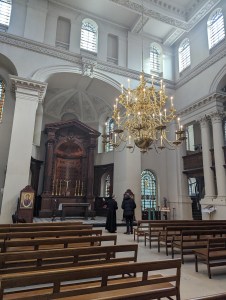
The hazy interior of St George’s church after the Sunday morning service, incense still hanging heavy in the air
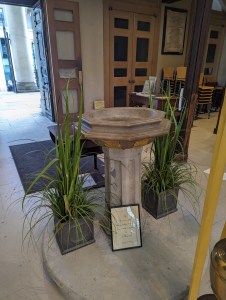
The font of St George’s Bloomsbury
When the family stepped outside, they would have been faced with squalor, overcrowding and poverty. Early nineteenth century Bloomsbury was not as we view it today. It was the edge of the huge rookery of St Giles. When William Henry and Mary were first married, they were living in Lascelles Place, which was a court off of what is now High Holborn, just to the North of the St Giles and St George’s workhouse, which had stood since 1725 but enlarged considerably later in the nineteenth century.

St Giles rookery in 1850 – Pierdon, Public domain, via Wikimedia Commons
In the ensuing years, more children were born but sadly, little William Henry died in infancy. Mary Elizabeth was born in 1829 followed by Frances, Harriet, Henry, Edward and George were all born between 1830 and 1840, and the family remained living in the Bloomsbury/ St Giles area. They resided either side of what is now High Holborn, in Duke Street – now West Central Street, to the north and Belton Street – now Endell Street, to the south. I recently visited the area with a measure of disappointment that their address, number 32, is now a sandwich bar in a modern building, and I found it hard to visualise the street, and the nearby workhouse, as it would have been in the 1830s.

Looking for signs of old Bloomsbury and the infamous St Giles rookery.
I am of the habit to search my ancestors for their criminal tendencies as these tend to be well-documented. However, it appears that William Henry was a law-abiding soul and he only appears in the Old Bailey online records once, and as a witness. In 1838 a pair of his chickens were stolen from his yard despite him having secured their quarters. Margaret Hardy was caught by a policeman with the two birds which William Henry could identify by their markings. The verdict was not guilty which does seem rather hard to believe but, I suppose that the birds being returned to their owner was the most significant outcome, rather than punishing a poor, and in all likelihood, hungry woman and her son.

My great grandfather, Charles Robert Apthorp, was born in 1850 when WIlliam Henry and Mary were living in the Long Acre area
The final two of William Henry and Mary’s children were James and Charles Robert, born in 1848 and 1850 respectively, the latter being my great grandfather. The family were living at 16 Brownlow Street, now Betterton Street on the edge of what we would call Theatre Land. These last children were baptised in the church of St Giles in the Fields. This was not a new church but, under the Commission that brought about the other aforementioned new churches, the parishioners of St Giles had also petitioned for an improvement of their damp old building. Henry Flitcroft, the architect of Woburn Abbey, designed the new St Giles in the Fields which was completed in 1734. Thus, it was that the Apthorps became worshipers in three of the most magnificent churches in the West End of London.

The interior of St Giles in the Fields with the font where my great grandfather was baptised
It was a surprise to me that in the 1861 census, the family had moved to Bird Street – now Monkton Street, in Lambeth. Mary had been born in Borough, Southwark but I have not been able to establish any motive for the move south of the river. William Henry, now aged fifty seven, was still working as a coach smith, as was son George, with second youngest son James working as a hatter. I have now discovered that this was the trade of his maternal grandfather so this may not have been a random career choice.

William Henry Apthorp in 1861, living in Bird St, Lambeth
The final census in which William Henry appears is in 1871, still living in Lambeth in John Street. His occupation is given as locksmith, which was probably less strenuous than his previous pursuits. He died in January 1872, aged seventy, and is buried in the Lambeth cemetery in Tooting. This caused me to study maps of the area closely, a place that I have not visited for forty years, since I lived there as a student. I find the coincidences that I stumble across fascinating. I was a regular attendee of social events held at St George’s Medical School student union on Friday evenings as a student. As a student of the University of London, this involved far less travelling than the trek north of the Thames to my own campus. Little did I know that in the churchyard opposite, lay my great great grandfather.

The final census in which William Henry Apthorp appeared in 1871, with my great grandfather still living in the family home in Lambeth
More information
St George’s Hanover Square – https://www.stgeorgeshanoversquare.org/history.html
St George’s Bloomsbury – https://www.stgeorgesbloomsbury.org.uk/about-us
St Giles in the Fields – https://www.stgilesonline.org/history
The St Giles Rookery – https://landmarksinlondonhistory.wordpress.com/2017/12/06/st-giles-rookery-the-lost-london-landmark/


 Awful Rigours and Wretched Pay

Leave a comment