By Christine Swan
This week, I thought I would I would introduce you to my adopted home city. It’s not the city of my birth as I am a Londoner through and through. In the 1980s, I realised that I probably would never be able to afford to buy a property in London any larger than my little flat, which had a garden so small that even a Swingball tennis game, took up too much space.
I’ve always been a city girl and loved my university years living in London’s heart – and it lived in mine. A spring wedding allowed me to glance through a few Worcester estate agents’ windows. I was astounded at the difference in price. The property boom had not yet stretched to the Midlands and it was definitely the case that you could get more bang for your buck. Within a few months, I had applied for, and obtained a position in Birmingham. The rest, as they say is history. A colleague in my East London school said: ” I hear that you are moving to a faceless part of the Midlands?” Faceless? Certainly not!
Worcester has a distinct identity but it’s hard to put your finger on it. A large number of its population were not born there, including myself, but once they visit, they stay and make it their home. This includes the Romans, who didn’t build any large buildings normally associated with a major city, Worcester was a small one, a bend in the river on the way to somewhere else. There is a Roman bread oven on display in the middle of the city library so some people did make their home here.
People who have lived in Worcester for many years have a very distinct accent. It is subtle and easy to confuse with somewhere else. “Buzz”, not bus, inanimate objects, that are not vehicles, are masculine, and Northern pronunciations of bath, class and glass. Sadly I hear fewer and fewer pure Worcester accents as people seem to prefer to sound as if they come from somewhere else. I suppose that I am as guilty as anyone else as my East London accent has faded too, but I’m not Worcester either – I’m in the middle and nowhere particular.
The largest building, one of the most ancient and beautiful, is the magnificent Cathedral. Founded in 680 AD. it has been extensively added to and remodelled over the centuries.

The River Severn in flood with the Cathedral as the backdrop
I will always remember a graduation event that I attended in 2001 just after the 9 11 attacks. There were some beautiful speeches and music that turned the already planned event into a powerful memorial. A wave of emotion crackled through the ancient building, and in the two minutes of silence that we held, it washed over me with incredible power. There is something quite extraordinary about Worcester Cathedral. It is a place to come together to celebrate, to remember, to mourn, to listen and to pray.

The Guildhall at Christmas
Worcester is known as the Faithful City and was the site of the last major battle of the English Civil War in 1651. Worcester remained loyal to King Charles II. The Guildhall, which I have written about previously, dates from 1723 and is a superb celebration of Queen Anne style splendour and an extravagant demonstration of the loyalty to the monarch.
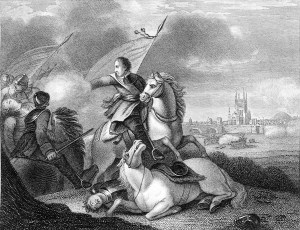
The Battle of Worcester with the Cathedral in the distance By James Caldwall – https://commons.wikimedia.org/w/index.php?curid=1943037
King George III was very impressed with the Guildhall’s Assembly Rooms when he visited in 1788, as was I when I visited in 2024.
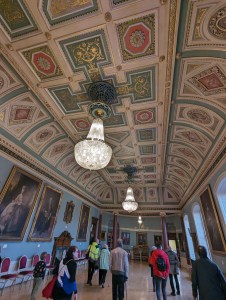
The Guildhall Assembly Rooms
Probably one of the most understated buildings is Queen Elizabeth House. Dating from 1570, it is a half timbered building from which Queen Elizabeth I addressed the good people of Worcester in 1575. Unbelievably, this historic building contains a series of offices and is not generally open to the public. However, as part of the Worcester Festival a couple of years ago, it flung open its doors for the residents with an inclination to like to nose around places that we usually cannot.
I stood on the balcony and imagined the scene: Elizabeth with her flame-coloured hair and ornate ruff, speaking to the crowd. In fact the House was moved in 1891 to accommodate road widening. It is suggested that this is the sole survivor of the Trinity Almshouses and that the association with Queen Elizabeth I was fancy, but it’s good to imagine and the house did bear her portrait above the door.
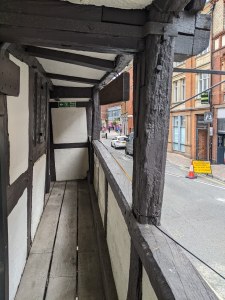
The gallery in Queen Elizabeth House from which she addressed the population of Worcester
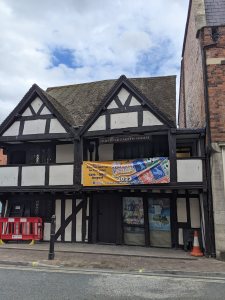
Queen Elizabeth House
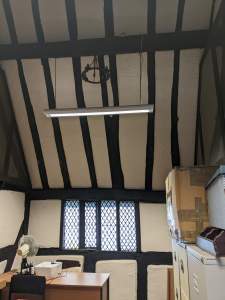
This incredible building is used as offices
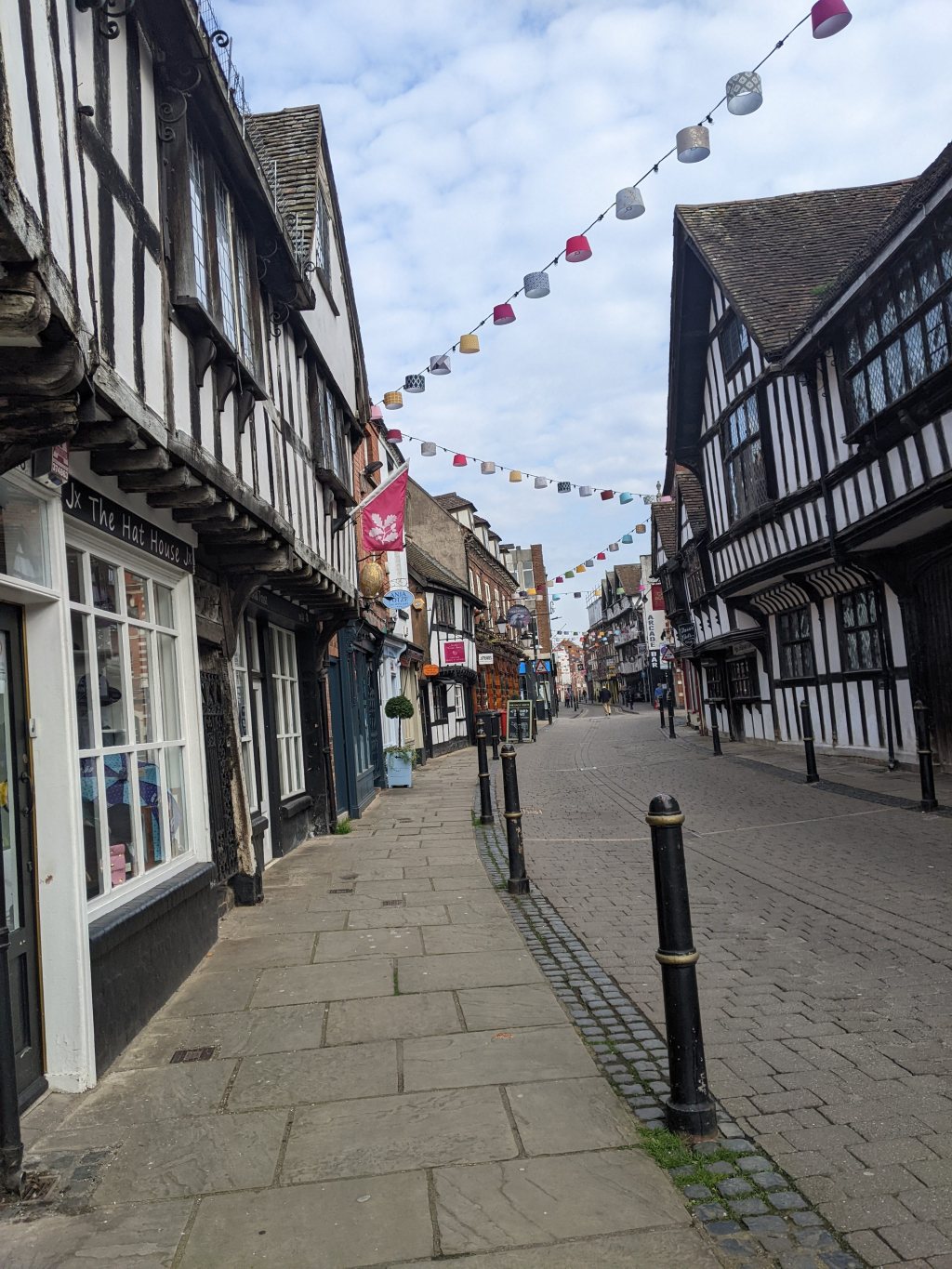
New Street and Friar Street form the historic quarter of the City and have a lovely stretch of half timbered buildings that are well worth a visit. Pubs and cafes are housed within very old buildings that serve very well in the twenty first century. There is a diverse mix of architectural styles but the end of Friar Street is sadly loomed over by a twentieth century, concrete car park. I suppose we should be grateful that some of the historic City survived when so many other parts were demolished. I heartily recommend a stopover at the King Charles House pub and similarly, The Cardinal’s Hat. They both present a memorable experience, the former with wobbly floors to match.
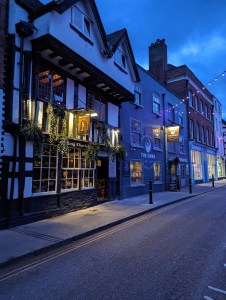
The King Charles House at dusk

The interior of the King Charles House alone makes for a memorable experience
I will feature other notable sites in Worcester in future posts. I find it hard to believe that we aren’t more prominent on the tourist trail but I think that we moan about the defects far too much and forget to extol the virtues.
Further information
Visit Worcester – https://www.visitworcester.co.uk/
Worcester Cathedral – https://www.worcestercathedral.org.uk/
Worcester Guildhall – https://www.worcesterguildhall.co.uk/
All uncredited images taken by the author
 Awful Rigours and Wretched Pay
Leave a comment