

By Christine Swan
Ellen Debben, or sometimes Dibben, was baptised in 1841 in St Pancras Old Church and was my great, great grandmother. Her father, Richard, hailed from Wimborne Minster in Dorset, and her mother, Charlotte Pocock, from Oxford. How did the family meet and find themselves living in Camden? The answer is very much of the time. London offered greater opportunities for employment, and more varied types of industry than rural areas. For women there would have been opportunities too, such as working in service. London had grown to be the second most densely populated city in the world at the turn of the nineteenth century and, as the years progressed, the number of inhabitants grew still further. The railways expanded rapidly after the opening of Euston station in 1837. At the time of Ellen’s birth, her father Richard was working as a carman, an occupation that I have described in a previous post, of which Ellen’s future husband James Cooke, was the focus. When Ellen was born, the Debben family were living in York Place, Camden, about three quarters of a mile from Euston station, the source of the daily work that her father undertook, transporting goods from the railway to their destination. York Place no longer exists but corresponds with part of Greenland Place and Kentish Town Road. Greenland Place is still cobbled with large warehouses in evidence even today, cranes indicating their former use.
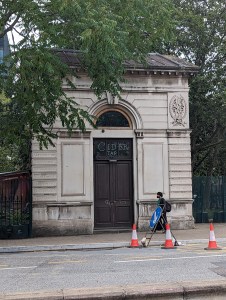
One of two original parts of the entrance to the original Euston Station
Ellen and her family had moved just a short distance to Bayham Street, which is now a mix of mostly modern housing and flats, with a few older houses, including one with an impressive coach house at the side. Perhaps this is the kind of home that the Debbens occupied along with their cart and possibly horse too. Ellen was a middle child of a brood of ten. Their house would have been very crowded so, as soon as the children became adult, they moved out and away. In 1861, Ellen, aged seventeen, was recorded as a visitor at nearby 11 Greenland Place, the home of Elizabeth Riches. Her occupation is listed as a servant. The household also had two lodgers living there so it is interesting that Ellen’s status was slightly different. Perhaps Elizabeth was a relative? This is definitely a line of enquiry.
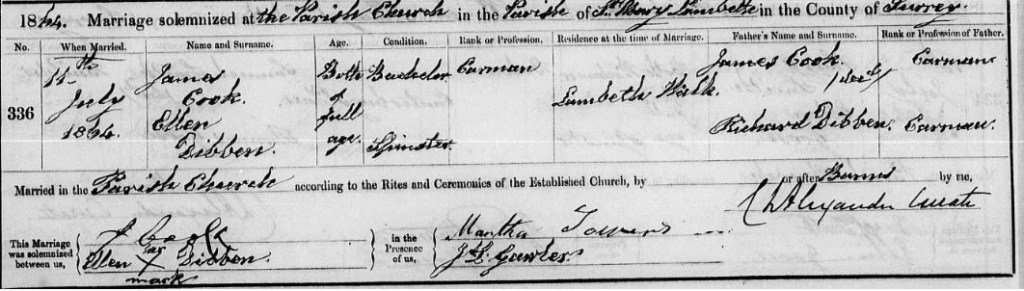
Ellen married James Cooke in 1864 – this time without an ‘e’
Wilmot Street, which forms part of the Waterlow Estate, was built in 1869. It now stands on the eastern edge of Weavers’ Fields, now an airy and spacious park. However, in the nineteenth century, there were rows of low cottages, often poorly constructed, and very cramped. These were the homes of the weavers of Bethnal Green, with their larger upper windows, to provide light for their industry. In 1938, discussions were held to propose the demolition of three streets. War delayed any development and led to destruction and damage of the area. It wasn’t until the late 1950s that demolition began, leaving the residents of Wilmot Street with considerably fewer neighbours. A fascinating history of the area and developments can be read here: https://wilmotst.com/584-the-lost-streets-of-weavers-fields/ . This is a detailed and comprehensively illustrated piece that is a fascinating read.

Tenement blocks on Wilmot Street
One interesting discovery that I uncovered was that Ellen was less than truthful about her age, or possibly, she was unaware of how old she was. In 1851, she was recorded as being ten years old, but was allegedly only seventeen in 1861. In 1871 , Ellen claimed to be twenty five years old, but twenty nine ten years later. In the final census record that I found, 1891, Ellen was recorded as being thirty six years old meaning that in a forty year span, she had allegedly only aged twenty six years. Perhaps she was forgetful or trying to retain her youthfulness, but it certainly is a puzzle.
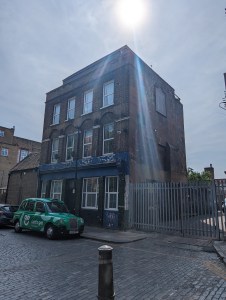
Cobbles and an old Truman pub in Tapp Street
Ellen’s husband James died in 1892 and despite much searching, the trail went cold. Ellen’s eldest daughter Julia, my great grandmother, died of pulmonary tuberculosis in 1912. Her youngest son, Emmanuel James, a veteran of World War I, died in 1922. I don’t know definitely what became of Ellen, but I pledged to write about all of my ancestors so that they will all be remembered. Ellen Debben adds ancestry from Dorsetshire and Oxfordshire into my familial mix, along with a strong thread of my beloved London town.
 Awful Rigours and Wretched Pay
Leave a comment