

By Christine Swan
My grandfather was just two years old when his mother died. He was the youngest child in the family and her passing would have been a cruel blow to the large family. My grandfather never spoke of her and it is likely that he couldn’t remember her.
Isabella Aylott was born in 1848 in West Ham, East London. At this time, it and nearby Stratford, were very much Essex, rather than London, and quite different to how they are today. Stratford is unrecognisable after wartime destruction and the more recent Olympic Games of 2012, altered the landscape dramatically. I can see the Olympic TV tower from many places in East London indicating that it is not too far away as the crow flies even though it is a long walk from the heart of the City.
Isabella was the eldest of seven children, three girls and four boys. Her father, William, hailed from Hoddesdon in Hertfordshire and was practicing as a lawyer when Isabella was born. In 1861, the family were living in Horsepond, near Laboratory Yard, Stratford. This was located in a heavily industrialised area just outside of the far more recently developed Olympic Park, close to the City Mill Lock. I was rather baffled as to why a lawyer would set up home, and presumably, business, in what appeared to be a Victorian industrial estate. 1871 found the family in Carpenters Lane and Isabella’s father, William, no longer working as a lawyer. Was he unable to find work? Instead, he took a job as a labourer in a jute works. Isabella went into service in Kennington Road, her sister Eliza was working as a machinist and brothers William and George, were working as match fillers. It is easy to assume that practicing law is a lifelong profession. It is hard to imagine what may have happened to change the family’s fortunes and drive them into more menial work.

The ArcelorMittal Orbit TV and observation tower, Stratford Olympic Park By Cmglee – Own work, CC BY-SA 3.0, https://commons.wikimedia.org/w/index.php?curid=18326095
Unusually, Isabella worked in an all-female household consisting of seventy eight year old Sophia Brooks and her twenty three year old cousin, Susannah Wade. Both Sophia and Susannah were single ladies with their occupation listed as embroideress. Sophia had lived with her sister previously before becoming head of her own household. Sophia died in 1880 and but it is interesting to note that Susannah went to live with her also unmarried sister who had also employed a general servant. I would have thought that for young Isabella, to work in an all-female household would have been a safer prospect than for many young women, although she would only have been employed for a few years.

Isabella Aylott working as a general servant in a female household in Kennington Road
Isabella married Charles Robert Apthorp when she was twenty five years old, in 1873, and her father William died one year later. They married in St John’s Church, Stratford, close to Isabella’s familial home. After this time, the Apthorps moved to Southend on Sea. As I have previously mentioned, I have no idea what prompted this move away from London but perhaps a fresh start in a new marriage was all the motivation that they needed. Since I wrote the post about Charles, I have learned that he was working as a printer while working in Southend. I have no idea why he tried his hand at this new trade but his new career was not to be long-lived.
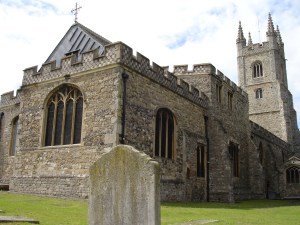
St Mary’s Prittlewell, Southend on Sea, By JohnArmagh – Own work, Public Domain, https://commons.wikimedia.org/w/index.php?curid=11295950
In approximately 1878, Isabella and Charles moved back to Stratford and Ernest Robert Joseph was born. The family were living in Barnby Street but later moved half a mile away to Lett Road. The 1881 census shows that the Apthorps hosted one lodger, Joseph F McGinn, 36, unemployed and, intriguingly, Ellen Carter, 13, listed as a daughter. Her name is above that of the lodger but, underneath the chronologically listed legitimate children. This leads me to believe that Ellen was an illegitimate child of either Charles Robert or, more likely, Isabella. Ellen’s birthplace is given as Romford and she would have been born when Isabella was eighteen years old. Could this explain why Isabella went into service? My great grandfather, George Betts was also illegitimate and was adopted by the Betts family as their son after initially being described as a visitor with his birth name of Mead before taking the Betts’ name. Carter could have been Ellen’s adopted name and she was returning to visit? Despite spending quite a few hours researching Ellen, I am still none the wiser.
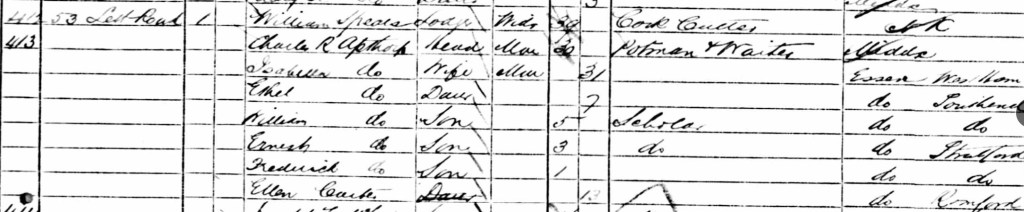
The Apthorp family in 1881, living back in Stratford and Ellen Carter living with them
By 1891 the family were living in Eve Road, West Ham, and had grown again with three more boys – Frank, Eugene and my grandfather Charles, or Charlie having been born. Their father, Charles Robert, was still working as a potman and Isabella would have had her hands full looking after the children. The oldest were also working, Ethel as a mother’s helper, William as an assistant potman and Ernest as an assistant barber, which would have contributed a small amount to the family coffers.

The Apthorp family in 1891 living in Eve Road, Stratford
The census was taken on 5th April but just over a month later, at the age of just forty-two, Isabella died. With seven children still at home, this would have impacted heavily on the family. Charles Robert had a harsh temperament. Ethel, his only daughter, acted as housekeeper, William went to sea, as eventually did my grandfather Charlie, the youngest of them all. Charles Robert eventually moved in with his daughter when she married. It is true to say that after Isabella died, it marked the end of the family that was. My grandfather did keep in touch with his siblings but my grandmother always resented how badly he had been treated by his father. My mother remembered some of her uncles and some had children of a similar age and they played together when they visited. As children, they had no idea of how The Great War had impacted on their lives just a decade or so earlier, or in what other forms tragedy might visit the family. There were happy times ahead too, some mysteries, family legends and just a whiff of scandal.
 Awful Rigours and Wretched Pay
Leave a comment