
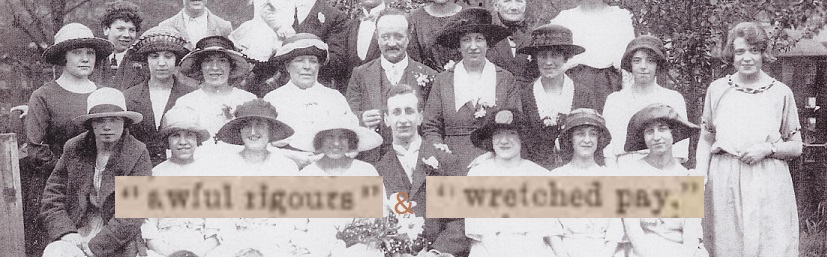

By Christine Swan
In 2017, I was carrying out some Continuing Professional Development for teachers of Computer Science on the topic of Object-Oriented Programming. My materials had been rigorously checked prior to the day so I found myself in London and at a loose end. I arrived the afternoon prior to the day that I was delivering the session so had several hours to fit something into. What amusement could a solo visitor find in the locality? I consulted a map and looked for sites within walking distance. I visited our old apartment block in Whitecross Street, visited St Giles without Cripplegate, where I was baptised and then returned to my hotel. What to do next?
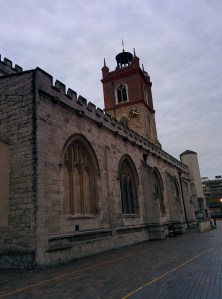
St Giles without Cripplegate
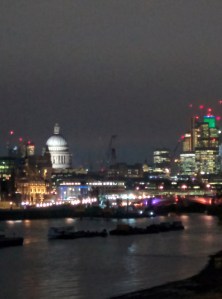
A chilly evening walk across London Bridge
It was a chilly November evening when I set out across London Bridge. The wind was biting so I wrapped my coat tightly around myself and headed North. I stopped for a warming cup of tea as I had arrived early. He café was brightly lit and I rather got the impression that the staff wanted me to drink up and depart as they swept around my feet and wiped down tables. When it was closer to my allotted time, I stepped out into the dark evening, and the chill wind snapped at my coat once again. I crossed into Folgate Street and headed for the house with the red shutters and lit lantern outside. I didn’t have too long to wait before the door opened and some people exited followed by a warm and welcoming host. I gave my name and I was permitted to enter. Time stopped. In fact, time went backwards. What was this place? I don’t know what I had been expecting but it wasn’t quite this. I have visited a large number of historic houses with static displays but this felt different. It had the clutter of occupancy, the grandeur of history and the warmth of a home.

Find the lantern in Folgate Street and you are in the right place
Myself and the other new visitors, were indicated to descend the steep stairs into the basement. I live in an old house but really struggle to retain original features and authenticity with the requirements of a modern home. The kitchen in Dennis Severs’ House has all of the authenticity and nothing has been compromised. It was lit by candlelight, with plates and food on the table. A chair with cushion was positioned by the range. All of the required implements for cooking and serving food were present and correct together with the heart of the home. A clock struck and I was sure that I heard voices.
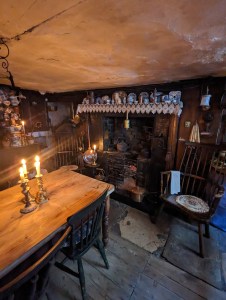
The cosy kitchen of Dennis Severs’ House
I climbed the stairs to the ground floor. If the kitchen is the heart of Dennis Severs’ House, then the drawing room must be its garments and the bedrooms its soul. Each room captures a specific period in the history of the house and its fictional inhabitants, the Jervis family. The drawing room has just been vacated. There is a half-drunk cup of tea on the table and a folded pair of metal-rimmed spectacles. The footsteps are just outside of the door and I am imposter. I hear voices but resist the urge to hide behind a piece of furniture. Beautiful pieces of ceramics and other decorative details tell me that this room belongs to the heyday of silk weaving in Spitalfields. This home belongs to a wealthy family who are successful in their line of work. Wood burns brightly in the fire grate and creates a warm and welcoming atmosphere.
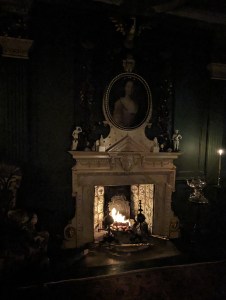
The roaring fire in the drawing room is a most welcome sight on a cold night
It is very difficult to describe the experience of visiting Dennis Sever’s House to anyone who has not experienced it. The sights, sounds, temperatures and textures define it uniquely. It is not a museum, nor is it an art gallery or stately home. It is an experience almost like time travel. I have silk weaving ancestry and felt an immediate and strong connection with the motifs. The house charts different periods of the evolution of the house, of the trade of its occupants and their resulting status. When silk weaving became unprofitable due to cheap imports, many producers and dealers headed towards destitution. My own five times great grandfather, William Deighton, was a trade representative for the Jacquard weavers. He, with others, led a march to Mansion House to protest.

Some of Simon Pettet’s wonderful delftware ceramics
I looked closely at a postcard on a bedroom wall – could I read the name Deighton? Dennis Sever’s House draws you in. The more you look, the more you see. As he said: “You either see it, or you don’t.” I believe that I did.

Deighton or Brighton? To me, it will forever be Deighton
Dennis Sever’s bedroom is a magnificent example of excessive opulence. It is a visual cacophony of ceramics, gilt and a huge fourposter bed. Behind a screen is Dennis’ computer, left as if he had gone to make a coffee and would be back shortly. Just like the older artefacts, the house appears to be inhabited by generations, both recent and historic.

The fireplace in Dennis Sever’s bedroom complete with incredible ceramic centrepiece

Nothing is expected and everything is extraordinary
Further steps take you to the period of hardship. In the cold November evening, away from the warmth of the fires, the rooms were cold. The wind howled outside and I had to duck to avoid the hanging washing. No gilt and sumptuous fabrics here. The bed looked frowsy and unwashed. It’s not a bedroom that I would have wanted to sleep in. I thought of my five times great grandfather, and his son, who continued to weave silk until he died in 1849. His daughter was Ann Deighton, who was the last generation of weavers in my family. I would like to imagine that between the generations, the family enjoyed some success in their trade, although probably not to the extent of the Jervis family.
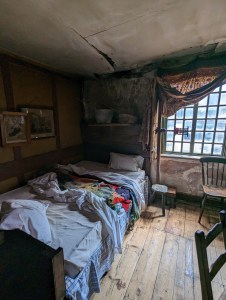
Hard times represented by the upper storey
I would recommend visiting Dennis Severs’ House to all but especially to those who have a shared family history link to silk weaving and Spitalfields. It is a powerful experience and stimulates imagination wonderfully. For anyone with an interest in social history and industry in East London, it is an absolute must. This is a significant historic site for all to enjoy. The house is costly to run and maintain but, thankfully, popular with visitors and has many friends and supporters. In addition to the Silent Night tours, a programme of talks, performances and special exhibitions are offered. There is something very special about the House that draws me back and encourages me to bring others with me. It’s not a secret, but it is addictive. The late Dennis Severs’ built something incredible. I urge you to experience it and lose yourself in three hundred years of history. When you step back into the street, you will wonder if your have lived a dream.
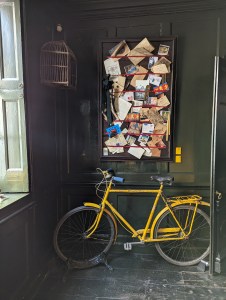
Simon Pettet’s bicycle. A poignant reminder of the House’s more recent history, loves and lives sadly lost
Further information
To book a visit, to learn more about the house and to support it through its online shop, please click here: https://dennissevershouse.co.uk/
Remembering Dennis Severs: https://spitalfieldslife.com/2022/07/08/remembering-dennis-severs/
To read more about the talented ceramicist Simon Pettet: https://www.theguardian.com/artanddesign/2023/oct/16/thrillingly-subversive-ceramics-simon-pettet-dennis-severs and here: https://spitalfieldslife.com/2023/04/23/simon-pettet-at-dennis-severs-house/
HIV AIDS took both Simon Pettet and Dennis Severs tragically from this world at a young age. You can support the work of the Terence Higgins Trust here: https://www.tht.org.uk/take-action/how-donate/donate-now
All photographs by the author.
 Awful Rigours and Wretched Pay
Leave a comment