

By Christine Swan
On Wednesday I was fortunate enough to be invited to take a look behind the scenes at Worcester’s historic Guildhall by the current Mayor, Louis Stephen. As soon as a I arrived, I recognised one of my neighbours so we proceeded to chat away while the group assembled in the downstairs hall.
When we were in entirety, we stepped outside to admire the magnificent exterior.

The entrance to Worcester Guildhall photographed by the author in 2022
The current building is not the first, but the second of Worcester’s guildhalls. The first was a medieval timber structure that was replaced in the eighteenth century after the end of the English Civil War. The building was designed by the sculptor and architect, Thomas White and completed in 1723. Queen Anne, King Charles I and King Charles II are represented above, and at either side, of the main entrance. Just as medieval stonemasons created gargoyles as a signature joke, so Thomas apparently used the emblem of a snail. Queen Anne apparently has one on her back and another, is depicted on a leafy scroll. I can see it – can you?
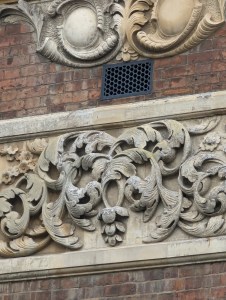
A stony snail crawls across a leaf, making no progress for centuries
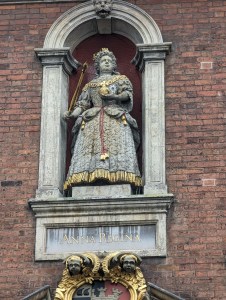
Queen Anne forever unaware that she has a snail crawling up her back
On the top of the building, in the centre stands Lady Justice. She gives an indication of one of the functions of the Guildhall, which housed both a criminal and civil court in the past. The former courtroom is now a committee room but the wood panelling indicates where the judge’s seat would have been as well as the site of the public balcony.

Lady Justice on the roof above the entrance
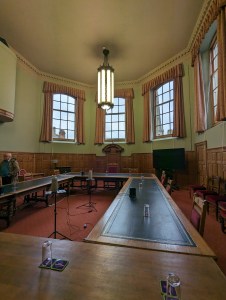
Formerly a court room but now a committee room
The downstairs hall is a large space that hosts receptions, meetings, craft fairs and charity markets. Portraits of previous civil figures decorate the walls as well as the leather buckets that formed the original fire protection system. Our host told us that fire drills were historically carried out that consisted of a human chain of bucket-bearers, stretching from the River Severn to the Guildhall. The downstairs hall has two ornate balconies, one of which is used to announce council election results and for new members to make their inaugural speeches.
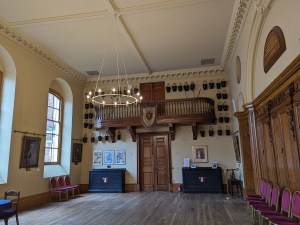
Leather fire buckets adorn the wall of the downstairs hall

Balcony from which council election results are announced
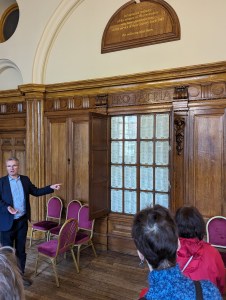
Louis shows us the World War I Roll of Honour detailing the names of all residents who fought for their country, usually concealed behind wooden panels
Prisoners awaiting trial, or for their sentences to be carried out, were held in the cells below the Guildhall. Although this was only a temporary holding facility, it is nevertheless, a grim place where many would have spent hours, and sometimes days, awaiting their fate. Louis showed us the window, with a grill at street level, where relatives could have passed food and drink to their loved ones as none other was provided. The death penalty was metered out to young and old alike, sometimes for what we could consider to be, petty crimes, such as small thefts. The public could attend to watch trials and, then later, public executions either outside of the Guildhall or, later, at the gaol in Castle Street. Transportation was seen as a more humane option, although, journeys were long and hazardous, in cramped and insanitary conditions onboard ship.
The story of Olivia Gascoigne is featured in the cells. She was tried in 1785 for armed robbery of coins worth £13 and 13 shillings. She was transported on the first fleet to New South Wales for life. Olivia remained in Australia, unlike my own ancestor, who returned after his sentence of seven years.

A cell set for longer occupation

A larger communal holding cell
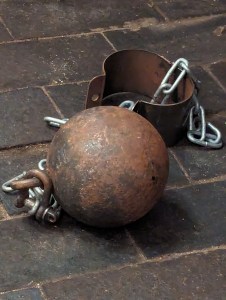
An old ball and slightly more modern chain
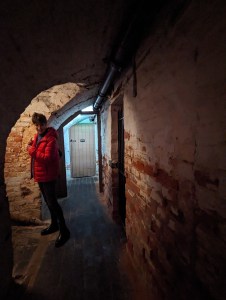
Dingy corridor leading away from the cells
The assembly room is the jewel in the Guildhall’s crown. It is a stunning venue that I remember from presentation evenings when I worked at the local technical college and from the afternoon teas that used to be a top choice for friends visiting Worcester from London. Glittering chandeliers and an ornately decorated ceiling makes this a magical place. Many a time I have walked along the High Street on a rainy evening, and looked up at the chandeliers sparkling. Only the great and the good would have been entertained in this place, ordinary citizens would have walked on by in the rain, as I did.
There is a small dais which has a piano which was played by one of Worcester’s most notable residents, Sir Edward Elgar, whose parents’ music shop was just on the other side of the High Street. As downstairs, the walls are adorned with paintings including a young Queen Victoria and George III to commemorate his visit to Worcester.
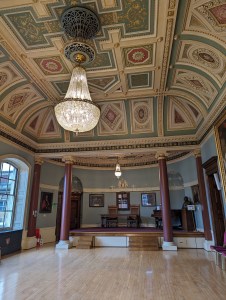
The magnificent assembly room stage end
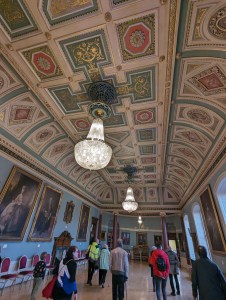
The far end of the magnificent assembly room

Bust of Sir Edward Elgar next to the piano

Portrait of a young Queen Victoria
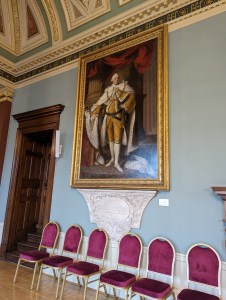
George III with a commemorative plaque underneath
We were also permitted to look around the council chamber which was full of photographic portraits of different generations of councillors which add huge depth to the place. So many decisions had been made in the past and would be in the future.
Our final stop was the Mayor’s Parlour Room which was a wood-panelled sanctuary with deep, squishy Chesterfield sofas and a myriad of interesting artefacts. Some had been gifts from official visits, and others historical. I imagined working here as I sank into a sofa with a cup of tea and biscuit. Actually, I don’t think I would work – I imagined that I would rather drink tea and have a nice afternoon nap. The enormous cast iron radiator threw out a vast amount of heat making it a very cosy office indeed!
We all had an opportunity to wield the sword of power, trying not to take anyone’s eye out. As you can see, I’m a somewhat awkward sword bearer.
I’d like to thank Louis Stephen for being such a well-informed, interesting and congenial host and also for arranging and facilitating the tour and refreshments. I would urge anyone interested in visiting to book via this website: https://www.worcesterguildhall.co.uk/visit/ . Worcester itself is well worth a visit as there are so many interesting places to visit that I will feature in future blog posts. You can find out more about visiting Worcester here: https://www.visitworcester.co.uk/
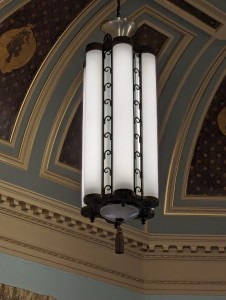
Rather beautiful deco lamps in the council chamber
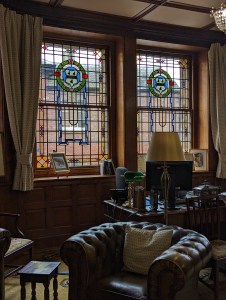
Now this is what I call an office
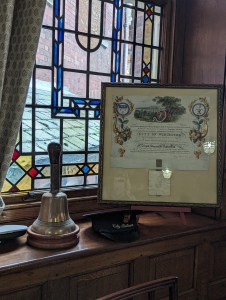
I’m not sure if Worcester still has an official bellringer but having been a teacher for so many years, this is pretty much like a school playground bell

No Louis, you can’t hide behind the sword!

Sheila Scott OBE, an incredible Worcester-born pilot who held many flight records including a solo circumnavigation of the globe. Thank you to Louis for making me aware of this amazing lady. You can read more about her life here: https://www.greatbritishlife.co.uk/lifestyle/23409364.sheila-scott-first-british-pilot-fly-solo-around-world/

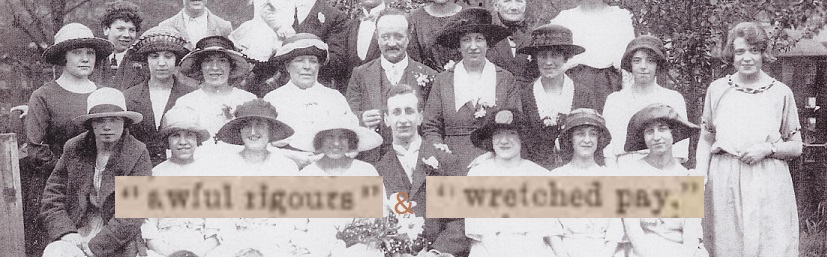
 Awful Rigours and Wretched Pay
Leave a comment