

By Christine Swan
When I was a small child, I was bought a cream-coloured jewellery box with a red velvet lining and a model ballerina, forever en pointe. resplendent in plastic with white lace tutu. Winding the brass key would cause the ballerina to pirouette to a music box rendition of Tchaikovsky’s Swan Theme. Alas, I was too clunky to aspire to such grace. I was tall, awkward, and good at chemistry. One of the nerd herd rather than the corps de ballet, but I could dream that I was elegant, admired and beautiful.
I have wanted to write about Elena since I first started this blog. Of all my ancestors, she is the person that I identify with the most. My paternal grandmother used to say: “You look like grandad’s aunt. She was tall like you. She was a dancer.” At some point in the 1970s, my father began researching our family tree and decided to visit the City of London Cemetery to clean a family gravestone. I remember that it being a cold day and although I tried to show some enthusiasm, I retreated to the shelter of the car and let Mum and Dad complete the cleaning and tidying. My grandmother told me about the lavish parties that Elena and her husband used to host in their large apartment in Old Kent Road and later, in Brixton. They were, by all accounts, generous, bohemian and to me at least, utterly captivating. Who was Elena, who I allegedly resembled? I must find out.
Elena’s birth name was Elena Ann Crudgington, daughter of Ann and Daniel Crudgington, born in 1854. In previous posts, I have written previously of the Crudgingtons’ chaotic lives where drinking, domestic violence and crime were a part of family life. Elena Ann was born into this but, she was to escape poverty and come to lead a comfortable and respectable existence.

Elena Ann Crudgington baptism 1854, St Matthias, Bethnal Green
At the time of her birth, the Crudgingtons were living in Bacon Street, Bethnal Green. In 1861, when Elena was seven years old, she wasn’t living with her parents. It is not beyond the realms of possibility that her dancing career had already begun.
Little Elena was signed to Mrs Conquest’s school of English dancing based at the Royal Grecian Theatre just off the City Road and next to the Eagle Tavern. Little girls were schooled in popular ballet as apprentices and were a desirable commodity to meet the need for large numbers of pantomime fairies. It was a hazardous business. Gas lights, flammable fabrics and flying stunts led to terrible accidents. As Elena was one of a huge number of pantomime fairies and music hall dancers, as a child, her contribution was one small part of the whole machine. She was probably given bed and board away from her family although I haven’t been able to locate precisely where in the 1861 census. In a newspaper article published in 1901, she said that she completed seven years of training with Mrs Conquest alongside a number of other girls, a number of whom also became successful in their own right such as Kate Vaughan. Clarissa Conquest died in 1867 although the Royal Grecian continued as a theatre until 1882 when it was purchased by the Salvation Army.

The Eagle Tavern in 1841 – later to become the Royal Grecian Theatre By John Shury (1814–1844) – British Museum., Public Domain, https://commons.wikimedia.org/w/index.php?curid=25568916
Elena was living with her parents in Baxendale Street in both the 1871 and 1881 census records and is described as a weaveress and machinist respectively. How could this be? Surely after the lure of the lights, the grace and beauty of the dance, to become a homeworker would have been a very restrictive existence. Elena had not given up on her dream.

The Crudgington family in 1871 living in Baxendale Street, Bethnal Green

The Crudgingtons in 1881 still in Baxendale Street
One issue that all family historians face is that performers use stage names. Linking the two names together is a major leap forward when conducting research. Fortunately, I was aware that Elena initially used a stage name of Nellie Estelle. My grandmother remembered her well and I loved hearing her recollections.
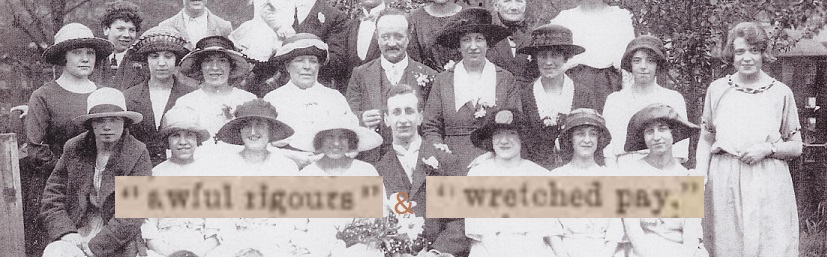
The earliest record that I have located of her performing was in July 1874 at the Alexandra Theatre in Ramsgate with fellow dancer, Milly Howes. In September, the two girls danced at Fredericks’ Palace of Varieties in Whitechapel, which is now known as Wilton’s Music Hall. Elena was twenty years old and pursuing her dream, no matter what she may need to do during the daytime. Elena and Milly had a theatrical agent, Charles Roberts, and they performed in their own right. I have read a number of articles implying that Victorian ballet girls were ripe for exploitation and may have substituted their income with prostitution. There seems to be an assumption that to be a ballet girl was a lowly profession with meagre pay and demanding, long, working hours. Elena refuted this in a newspaper article written later in her life. As I have read about her, often in her own words, I have come to know her as an ambitious and competent businesswoman as well as being passionately dedicated to her craft. She may have also been a weaveress and machinist, but these were not her career. The Era published on the 6th of September 1874 predicted that Nellie and Milly would become popular with Music Hall frequenters even though they were relatively unknown at the time.
In 1875, Nellie had a new dance partner – Carrie Pacton. Numerous articles pour praise on the duo who were busy touring music halls up and down the country. The pair continued to perform together until 1880 when Nellie Estelle appears as a soloist. If you recall, she was still living with her parents, at the very least, when the census was recorded in 1881. Nellie was not to remain a soloist for long. She would change her stage name, change her fortune and form a lasting partnership that was to survive for over thirty years.
Further reading
Monomania Into the limelight – women in the music hall. Ballet girls. [online] Available at: https://intothelimelight.org/2021/09/03/__trashed/ [Accessed: 15/12/2023]
Witchard (2011) Bedraggled ballerinas on the bus back to Bow: The fairy business [online] Available at: https://19.bbk.ac.uk/article/id/1498/[ Accessed: 15/12/2023]
Image of Elena Newspaper image © The British Library Board. All rights reserved. With thanks to The British Newspaper Archive (www.britishnewspaperarchive.co.uk).


 Awful Rigours and Wretched Pay
Leave a comment