
By Christine Swan
Daniel Crudgington is possibly my 3x great grandfather. Born in 1815 in Spitalfields, he was transported to New South Wales in 1834. In this post, I will explore his return to England and middle years.
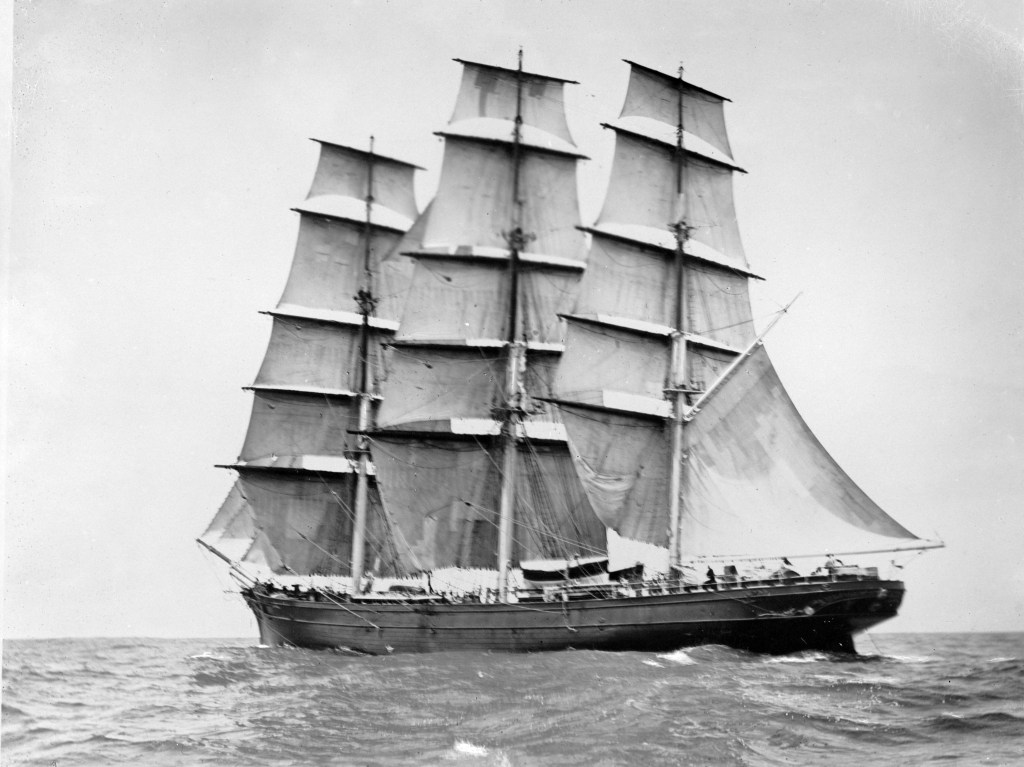
By Allan C. Green – This image is available from the Our Collections of the State Library of Victoria under the Accession Number:, Public Domain, https://commons.wikimedia.org/w/index.php?curid=15656203
Daniel Crudgington was issued a Certificate of Freedom as a transported convict on 1st May 1841 from the Superintendent for Convicts Office in Sydney. It was an ill wind that returned him to England shortly after. I believe that he worked his passage as he is listed as a merchant seaman. He didn’t waste any time in marrying a widow, Jane Andrews (nee Vincent) on 21st February 1842. Did he know her previously? Did she have a link to his convict past? At this point dear reader, I cannot be certain. Both of his parents, John and Frances Crudgington, witnessed the marriage at the church of St George in the East.

St George in the East Church Photo taken by Martin Klussmann; Transferred from en.wikipedia to Commons.; description page is/was here., Public Domain, https://commons.wikimedia.org/w/index.php?curid=4414780

Marriage record of Daniel Crudgington and Jane Andrews, 21st February 1842
My father told me that Daniel was married to an Ann, not a Jane so I assumed that this first marriage must relate to another Daniel but why would they have exactly the same parental names? In July 1844, Daniel married Ann Dighton (or Diton – a corruption of the spelling) at St Dunstan’s church in Stepney. I am of the opinion that Daniel’s marriage to Ann Dighton was bigamous. His first marriage could possibly have been annulled but, if this involved any legal process, I think this unlikely. Divorce was only for the wealthy, very rare and had to be agreed by Parliament. The only permissible grounds were adultery. I have not found a record of Jane, his first wife, dying and Daniel claimed to be a bachelor when he married Ann. His mother, Frances, was a witness to the marriage, again and his father’s details match the previous marriage record. Bigamy was, from my research, not uncommon in the nineteenth century and was tolerated by the community. Even later legislation trod lightly and compromised when both parties were honest about their predicament. Daniel Crudgington, was not an honest man.
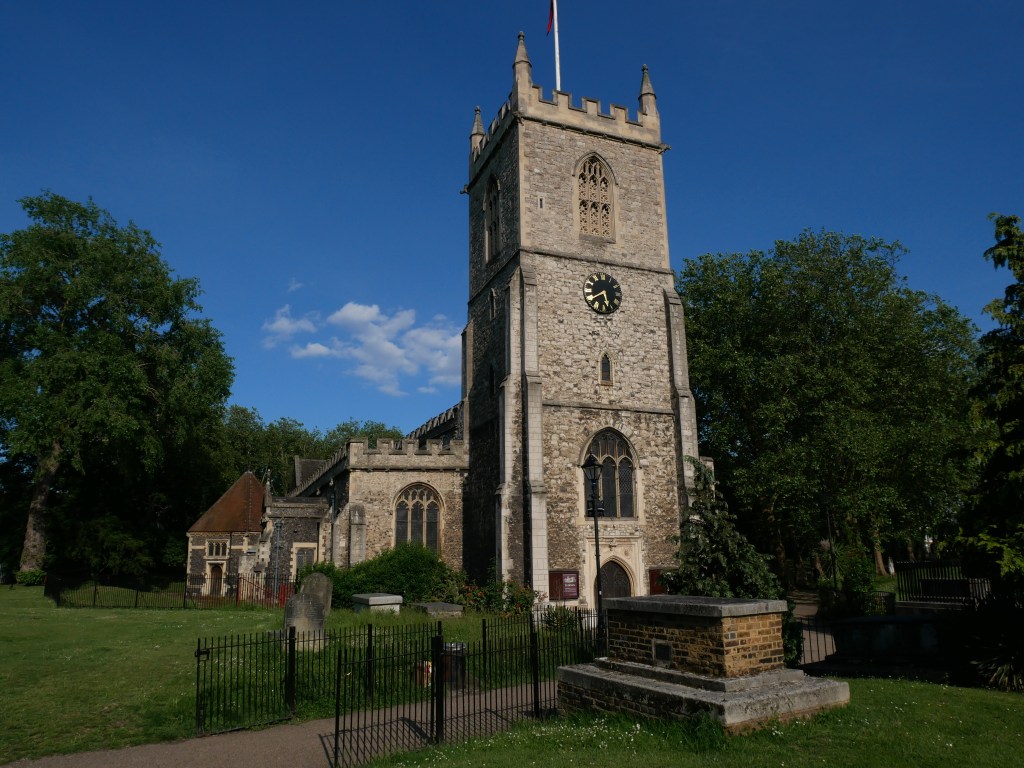
St Dunstan’s Church, Stepney
By Ethan Doyle White – Own work, CC BY-SA 4.0, https://commons.wikimedia.org/w/index.php?curid=107007279
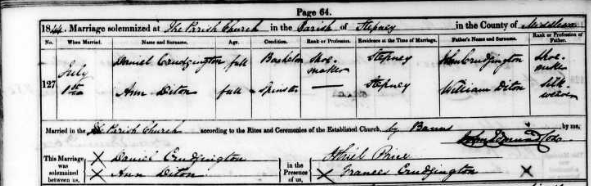
Marriage between Daniel Crudgington and Ann Diton (Dighton), 1st July 1844
Jane Vincent, or Andrews is somebody who I will continue to research. What were the circumstances in which he abandoned her and married Ann? Was Ann pregnant and that was why he left his first wife? I do feel some sympathy for Jane. Maybe the union was split on her part and she left the marriage. Later events cause me to have some admiration if this was indeed the case. Jane doesn’t appear to have carried on using the name Crudgington but her story is one for another post.
My great, great grandmother, Mary Ann Dighton, or Crudgington, was born in 1842. I don’t have any proof that her father was Daniel, but I do know that her mother was Ann. She doesn’t appear in many census records so there has had to be a little bit of guesswork and triangulation to piece all of the evidence together.
Unfortunately, there was little domestic bliss in the Crudgington household. Alcohol led Daniel down a very dark path of destruction and further criminality. On Christmas Eve morning in 1847, he, together with Joshua Kemp and another unnamed individual who remained apart from the ensuing events, had been drinking and happened upon a workman, William Ives toiling on Cambridge Heath Road shovelling materials. Crudgington shoved Kemp into William Ives causing him to stumble. William asked why they did so. An argument ensued which resulted in Daniel threatening Ives. Crudgington then threw two punches but Ives defended himself with the blade of his shovel. Kemp snatched the shovel away and hit William hard in the side with it. William Ives stumbled back and Crudgington punched him again. Some passers by went to fetch a police officer while the three drunkards went on their way, laughing as if no event had occurred. Some witnesses followed along in pursuit.

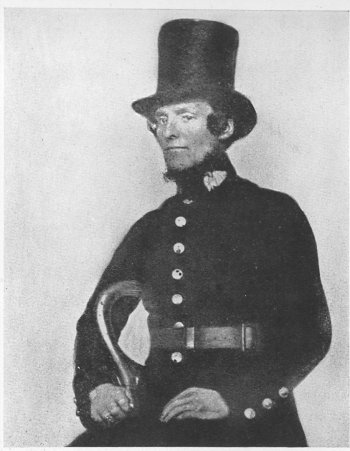
A Victorian “peeler” police officer
Victorian police officer 1850s By Unknown author – http://www.victorianstrollers.co.uk/stevesuniforms/peeler/peeler1.jpg, Public Domain, https://commons.wikimedia.org/w/index.php?curid=8973524
At 11am, one police officer managed to apprehend Kemp, who was identified by Ives, who had also left his work party with the police to locate the assailants. Crudgington went to Kemp’s rescue, punched, kicked and jostled with the officer. Kemp made good his escape and Crudgington kicked the first officer to the ground before making his own getaway. Kemp was eventually overpowered by multiple officers and a courageous member of the public. Daniel desperately ran to hide in a local brothel shouting that he would: “dash out the brains of anyone trying to approach him”. The following struggle was brutal, in which Crudgington punched and kicked several officers before they finally managed to handcuff him and take him into custody.

Royal London Hospital (Formerly the London Hospital)
By Eliasaris at English Wikipedia – Transferred from en.wikipedia to Commons by Rcbutcher using CommonsHelper., Public Domain, https://commons.wikimedia.org/w/index.php?curid=12276102
William Ives was not a strong man and was taken to the London Hospital, in Whitechapel, after the assault but later returned home to recover from his injuries. At that time, he had also contracted smallpox and by 2nd January 1848, was exceedingly ill. A surgeon was fetched and although there was some small hope of recovery, Ives was dying. The information that later came to light during a post mortem examination was that he had four broken ribs, a bruised spleen and stomach as well as smallpox. He had hung between life and death for some time during which his poor wife, Margaret, sold everything that she could to provide for the family because she had no other means. The children also became ill with fever and Margaret applied for relief from the magistrate in her desperation. It seems that the good people of Bethnal Green contributed to her tragic cause, and generous donors were identified in the press only by their initials.

Newgate prison in the early 1800s
By George Shepherd – http://www.allposters.com/-sp/West-View-of-Newgate-C-1810-Posters_i10060918_.htm, Public Domain, https://commons.wikimedia.org/w/index.php?curid=681491
Kemp and Crudgington appeared at Worship Street initially after their apprehension. Bail was refused and they were placed on remand in the infamous Newgate prison. They appeared before magistrates again on 31st December 1847 while William Ives was still alive but seriously ill. Kemp claimed in his defence that he only acted to defend Crudgington and the latter said with arrogance that he would reserve his comments for a later occasion.
An inquiry was held at the Jolly Anglers, Lea Bridge Road on 13th January 1848. Before he died, Ives had given a statement to a magistrate on 9th January. This statement was read and the inquiry adjourned. Ives’ statement confirmed that he had not offered any insult and that the attack was unprovoked as witnesses also had testified.

Central Criminal Court – The Old Bailey
By Nevilley at en.wikipedia – w:Image:Oldbaileylondon-900.jpg, CC BY-SA 3.0, https://commons.wikimedia.org/w/index.php?curid=3171920
Kemp and Crudgington were tried at the Central Criminal Court on 31st January 1848, more than a month since the original assault. The surgeon who performed the post mortem testified that the cause of death was indeed smallpox but that the combined effects of the assault and ensuing injuries had been a contributory factor to his demise. Crudgington and Kemp were both found guilty of manslaughter and sentenced to one year’s hard labour at Newgate prison.
Just one year.

Newgate exercise yard
By Héliodore Pisan after Gustave Doré – http://family-tree.co.uk/familyblogs/bessie/2008/01/27/whatmores-at-the-old-bailey-part-1/, Public Domain, https://commons.wikimedia.org/w/index.php?curid=5274339
I confess, I was speechless. My history teacher friend told me that life was cheap but property was valued. At this point, I feel like slamming my laptop shut and walking away. The awfulness of the situation makes it impossible to detach oneself. Opening a newspaper in our current age will turn up stories of drunken violence and loss of life due to knife crime but, we do not necessarily feel a human connection unless we hear from those most affected. The impact on family and friends is a mirror to the human condition. We must feel some part of their suffering and respond with kindness. I visualise Margaret Ives, desperately poor, her single means of support taken away and she left bereft. Daniel Crudgington and Joshua Kemp did this.
Why on Earth did he assault a man who was simply maintaining the road and offered no threat or insult? It was a wicked and entitled act. They assaulted William Ives because they were drunk and because they could. It’s easy to make excuses and say that life was hard then or that they were poor – both of which were true, but this is about character. My father had told me that I would find skeletons in the family cupboards. This was the first skeleton that I discovered and, more than others, what I feel is shame. Ives was also a poor man, but sober and doing honest work, with a wife and young family. I cannot excuse, I cannot forgive.
In the press, Kemp and Crudgington were described as “notorious ruffians”. I get the impression that Crudgington might have taken pride in his notoriety. He could do what he liked and nobody could stop him. He could be as outrageous as he could.
In 1949, Daniel was found guilty of assaulting his wife. Domestic violence was not uncommon among working class families. Women had few rights and it was only in 1857 that the first protective legislation was passed. In fact, it was a humane society for the protection of animals that was associated with early legislation to protect women. Daniel’s address was given as 6 John’s Place, Stepney. This area has now been swallowed by a modern housing development close to Sidney Street. The press articles detail a horrible beating with his wife being punched in the face and then beaten with a bed rail. She was found naked and bruised after the police were called as a result of cries of: “Murder!” Both were apparently drunk. For this offence, Daniel was fined 40 shillings and three weeks’ imprisonment upon default.
Was this Ann? Was this Jane? Was it somebody else? I have no way of knowing. Mary Ann, my great, great grandmother would have been just seven years old. Was she there? Was she safe? Life for women like Ann was very hard. Could she have got away? Unfortunately, once married, escape was virtually impossible.
Additional sources
The British Newspaper Archives [online] Available at: https://www.britishnewspaperarchive.co.uk/ [ Subscription required]
The Proceedings of the Old Bailey – Daniel Crudgington and Joshua Kemp – Manslaughter [online] Available at: https://www.oldbaileyonline.org/browse.jsp?id=def2-617-18480131&div=t18480131-617#highlight [Accessed: 15/03/2023]
Holmes, V. (2020) ‘Rip the feather bed open’: Domestic Violence and Working-Class Marriage in Victorian England [online] Available at: https://drvickyholmes.com/2020/06/06/rip-the-feather-bed-open-domestic-violence-and-working-class-marriage-in-victorian-england/ [Accessed 15/03/2023]
 Awful Rigours and Wretched Pay
Leave a comment