
by Christine Swan
When we embark upon the journey to discover our family history, it is natural to hope to uncover heroes, riches, fame and noteworthy achievements. Daniel Crudgington was an unusual name so internet searches were unlikely to return an unmanageable number of results. Therefore, this was a good place to start!
My father told me that Daniel was a shoemaker and born in Spitalfields. In every census, he gave this as his birthplace. As a child, I read the story of the Elves and the Shoemaker by the Brothers Grimm. In the most commonly told version, a poor shoemaker with limited resources, is helped by elves who make additional shoes, working in secret overnight, for him to sell. Thus, my vision was set of a kind, elderly gentleman, of limited means, slaving by candlelight, making beautiful footwear by hand – a sort of Victorian, East End, Christian Louboutin or Manolo Blahnik. But where did the elves find the additional resources for the shoes? Dear readers, it did not take me long to discover the answer.
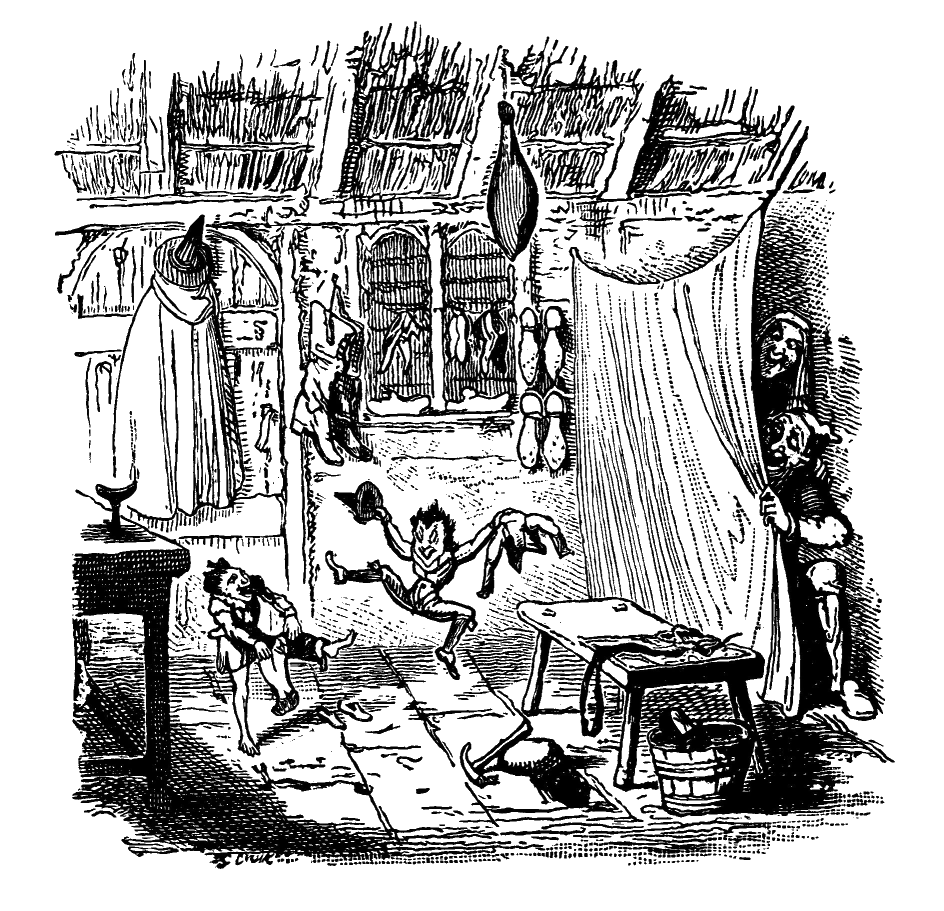
The Elves and the Shoemaker
By Unknown, likely George Cruickshank ? – Elves and the Shoemaker, originally from The Book of Fables and Folk Stories, by Horace E. Scudder, Boston: Houghton Mifflin Company, 1915., Public Domain, https://commons.wikimedia.org/w/index.php?curid=3799966
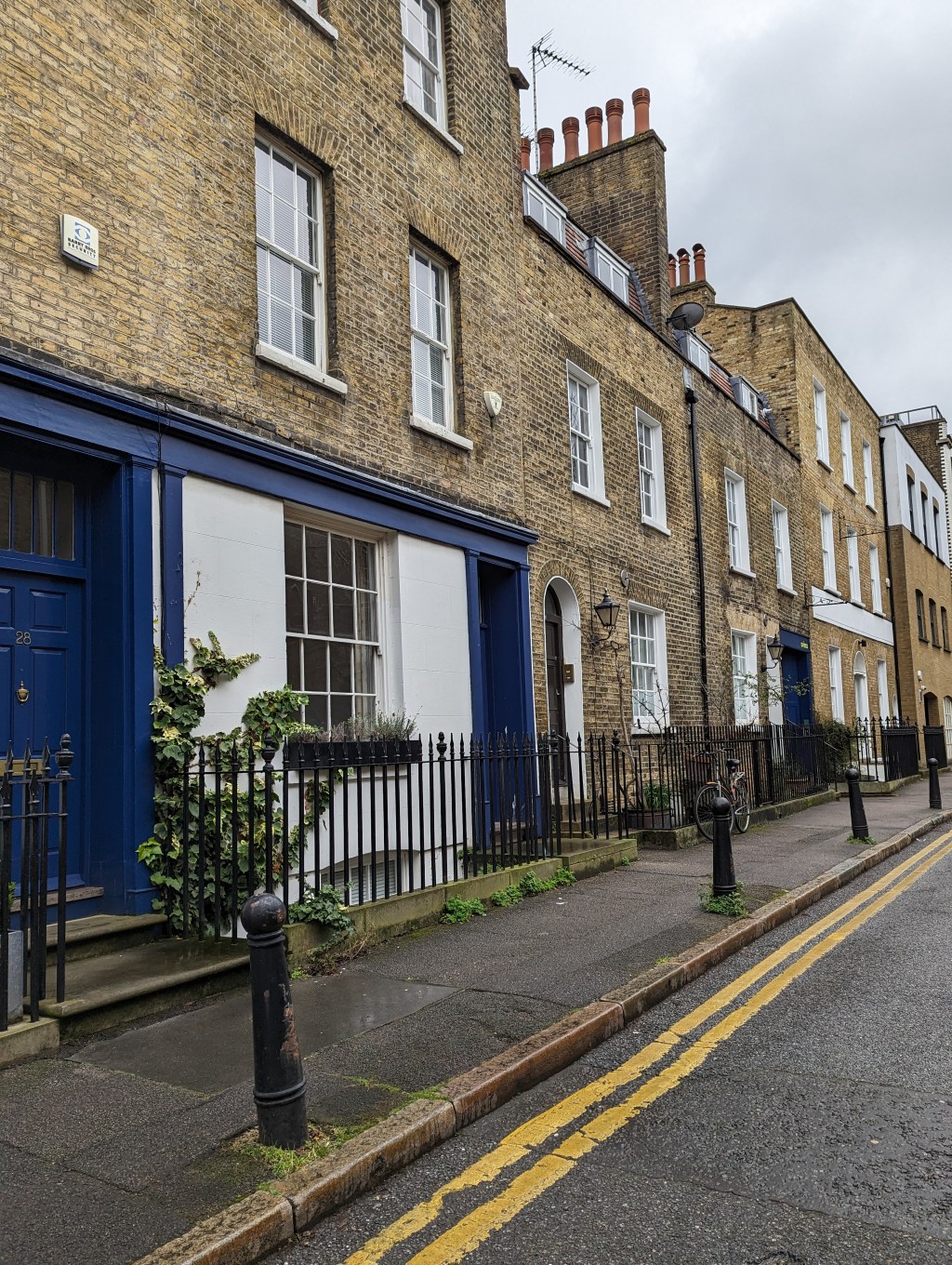
Daniel was born on 3rd May in 1815 and was christened in St James church, Clerkenwell on 14th April 1816. His parents, John and Frances Crudgington, also shoemakers, were living in King Street, which is now Cyrus Street. Unfortunately, the area has been redeveloped considerably but their address is given as “Con R”. Sadly, I wasn’t able to locate precisely where this was or the type of building however, there are some in the locality that date from the early nineteenth century as part of the Northampton Square development. Clerkenwell has an air of traditional grandeur although, I believe that large blocks housed poor families in the nineteenth century, as elsewhere in the city.

St James Clerkenwell (photographed by the author)

Interior of St James Clerkenwell (photographed by the author)
Daniel, as the eldest son of John Crudgington, followed his father into the trade. More children came along and the family relocated to Flower and Dean Street, North Street and then Collingwood Place. The latter two addresses became synonymous with the Crudgington family. John was not entirely an honest character and in 1827 was tried at the Old Bailey with co-defendant David Baron, for stealing a sow. It was an elaborate crime and I can’t think that animal would have made for an easy theft. Both were found guilty and imprisoned for six months. In 1834, when Daniel was 18 years old, he was found guilty of stealing a pair of shoes from a second-hand shoe shop in Charles St owned by Lucy Flynn. Daniel was imprisoned in Clerkenwell jail and his Middlesex Quarter Session trial date set for 7th April. His mother, Frances, had gone to the jail at 1pm to enquire what time he was due in court but was told that it wouldn’t be held yet and that she should go home to have dinner and then return. When she did, she was told that her son had been convicted and sentenced to seven years transportation to Australia at 3.30pm that afternoon. I was quite shocked by this sentence. Thinking about the modern penal system, I would hope that a petty theft would be investigated but the perpetrator would be given a fine but some attempt at rehabilitation might have been undertaken. Seven years transportation would have been devastating. A good friend, who is also a history teacher, told me that theft could have resulted in the death penalty in the 1700s. Jurys became reluctant to find people guilty for relatively small crimes if they knew that it would result in execution. Transportation presented a more merciful punishment and jurors might have felt their conscience was clear. About half of all those found guilty and sentenced to transportation received a term of seven years. Additionally, many convicts chose to remain in the colonies, as free citizens once they had completed their term and earned a certificate of freedom. But Daniel was a young man and the prospect of being sent to the other side of the world with little prospect of ever seeing his family again, must have been devastating and terrifying. Whatever the failings of the Crudgington family, I imagine the anguish that Frances must have felt when she learned that her first child, her boy, was gone.
The family rallied and organised a petition to be sent to Viscount Melbourne, Secretary of State for the Home Department but to no avail. The petition is an extraordinary document and signed by no fewer than twelve local residents vouching for Daniel’s character and for the impact that the absence of their eldest son would have on the poor Crudgington family.
2nd Viscount Melbourne – William Lamb (Home Secretary and later Prime Minister)
By John Hoppner – Royal Collection, Public Domain, https://commons.wikimedia.org/w/index.php?curid=92099226
Daniel was held on the Fortitude prison hulk at Chatham before being transferred with 99 others to the Lady Nugent on the 26th November 1834. By this time, I assume that Daniel had been on the hulk for about seven months. Upon researching the dreadfully overcrowded conditions, these were places where communicable disease could thrive as well as that caused by poor diet and hard labour. However, Daniel was young and strong so survived in preparation for his epic journey.
I wonder if he considered escape? I read Dicken’s Great Expectations as a set text at secondary school. The escaped convict Abel Magwitch, flees the prison hulk in which he was incarcerated. Convicts did not idle their time on the hulks. They were put to work improving the docks and navigation of the River Medway. Ultimately, Magwitch does get caught and transported so maybe it would have been a hopeless endeavour for Daniel too. Unfortunately, the character reference provided in the petition was inaccurate if the hulk muster was to be believed as it stated that he had already been in prison twice for larceny. Perhaps this was the fresh start that he needed?
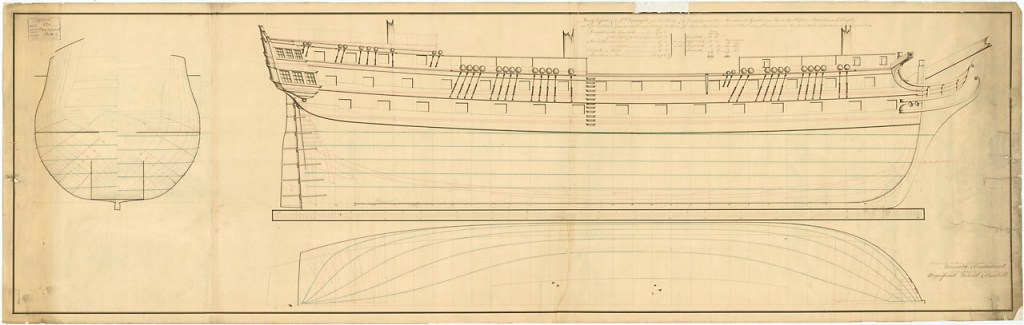
Drawing of a prison hulk
HMS Cumberland (which became the prison hulk HMS Fortitude) By William Rule – https://www.rmg.co.uk/collections/objects/rmgc-object-80900, Public Domain, https://commons.wikimedia.org/w/index.php?curid=32726410
Daniel was transported, as one of 286 convicts, on 3rd December 1834, bound for New South Wales The Lady Nugent arrived on 9th April 1835. The surgeon, Oliver Sproule, dealt with a number of conditions onboard and, to his credit, cured a number of ailments, including seasickness stating that: “the sight of land, however, did him more good than all the medicine in the world, for he got quite stout during the short period the prisoners were detained on board after our arrival”. Daniel is not mentioned in the surgeon’s records so I can only assume that he retained some portion of good health and took to life on board ship as best he could. Two convicts died on the journey but fortunately, there were no outbreaks of serious transmissible disease. Sproule appeared to be guided by good sense and ensured that convicts had access to fresh air when the weather was fine after they had rounded the Bay of Biscay. Prior to that poor weather and leaks had led to forward bunks becoming soaked. There were some musicians among the convicts or crew and this seems to cheered the party. The hornpipe dance was certainly of the period and no doubt gave the convicts an opportunity to enjoy some limited time above deck with musical accompaniment.

The Lady Nugent in high seas
Hilliard, George Richard (Dr), b 1801. [Hilliard, George Richard] b 1801 :[The Lady Nugent on the high seas] 1840. Ref: A-113-016. Alexander Turnbull Library, Wellington, New Zealand. /records/23168647
After the Lady Nugent docked at Port Jackson, convicts were disembarked on 27th April and marched to Hyde Park Barracks. To my amazement, the barracks have been preserved and are now a UNESCO protected living-history museum. At the time when Daniel arrived, in the midst of a peak in transportation numbers, convicts were deployed to labour gangs building roads or were posted out of the city to work on settlers’ farms. This was enforced labour and we have to remember that Daniel Crudgington had only stolen a pair of second-hand shoes.
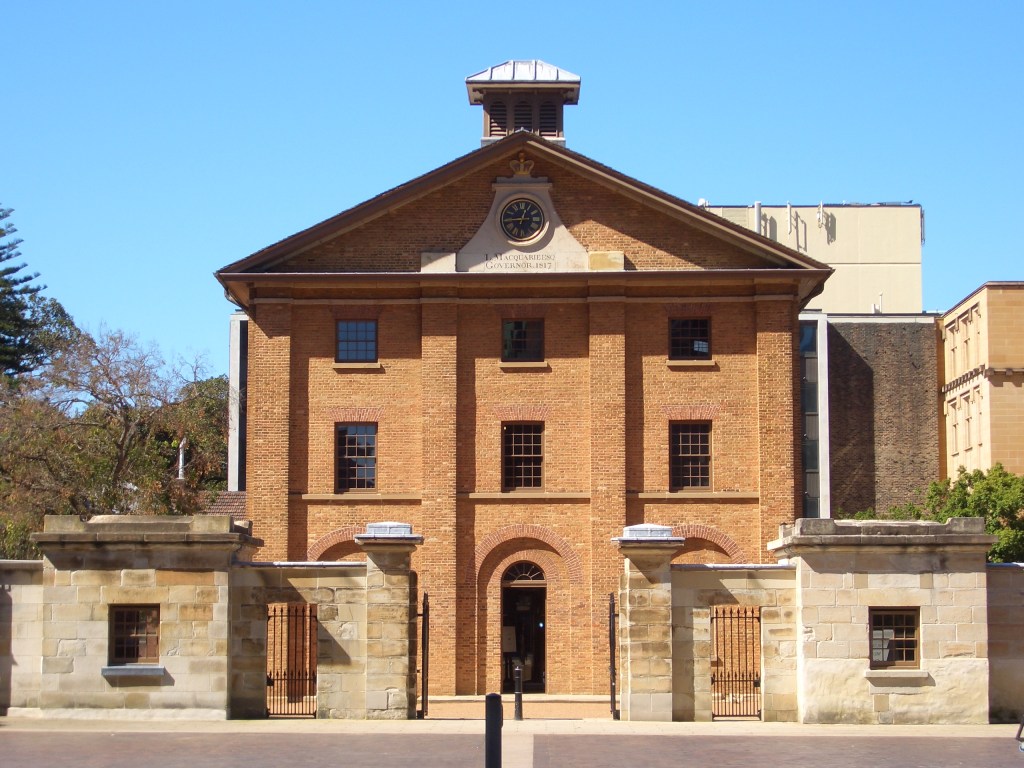
Hyde Park Barracks, Sydney, Australia
By The original uploader was J Bar at English Wikipedia. – Transferred from en.wikipedia to Commons by Berichard using CommonsHelper., CC BY-SA 3.0, https://commons.wikimedia.org/w/index.php?curid=8053482
Daniel was tattooed on both arms and the indent provides a detailed description of all of these. I wondered if these were carried out on the journey. An anchor, a bottle and, curiously, three dots, were among his tattoos. Daniel was five feet, five-and three-quarter inches tall with a ruddy complexion, fair hair and grey eyes. Even in the absence of a photograph, I can build a picture of his likeness. His temperament was described as tolerable which, I suppose, is better than intolerable. If he was a petty criminal before transportation, he would have met some more hardened criminals both on his journey and when he arrived.
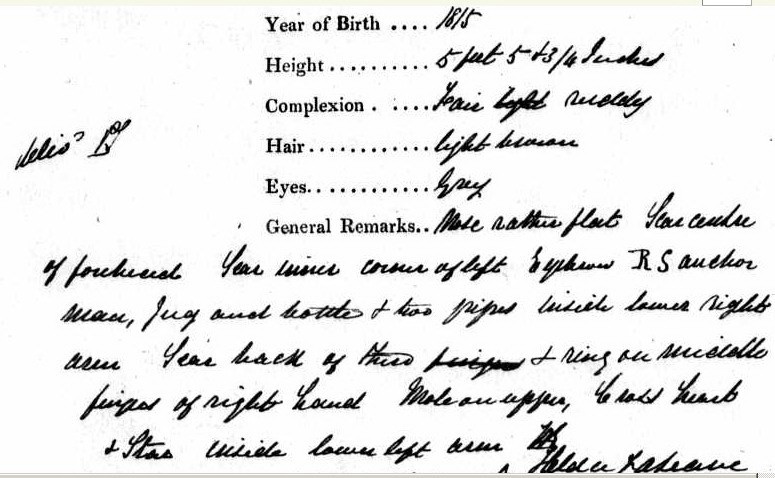
Daniel Crudgington Ticket of Leave 1840
State Archives NSW
The ensuing years are a bit of a blank. I know that he served his term and worked out his sentence. Daniel gained a ticket of leave in 1840 issued from the Goulburn district bench. This would have enabled him to move about within the locality. From his location, I can imagine that he was deployed building roads as the local museum details of how convicts were set to work in the district. At some point in 1841, a letter was detained at the Sydney Post Office due to insufficient sea postage to, or from, England. The letter was bound for Dog Row in Whitechapel, London. The correspondents were Daniel and his father John. Daniel was going home.
Additional sources
Blue Anchor Corner – Home to the Seasalter smuggling company Philip Atherton Life inside the prison hulks – staying alive Available at: https://seasaltercross.com/2015/03/18/life-inside-the-prison-hulks-staying-alive-2/ [Accessed: 5/03/3023]
Medical and surgical journal of the convict ship Lady Nugent from 7th November 1834 – 27th April 1835 The National Archives Available at: https://discovery.nationalarchives.gov.uk/details/r/C4106709 [Accessed: 05/03/2023]
The proceedings of the Old Bailey – London’s Central Criminal Court 1674 – 1913. In Associated records Daniel Crudgington March 1834 Available at: https://www.oldbaileyonline.org/search.jsp?form=associatedRecords&_associatedRecords_defsur=Crudgington&_associatedRecords_offence=&_associatedRecords_trials=&_associatedRecords_doctype=&_associatedRecords_description=&_associatedRecords_libarch=&fromMonth=&fromYear=&toMonth=&toYear=&submit.x=56&submit.y=9 [Accessed: 05/03/2023]
Free Settle or Felon – Lady Nugent 1835 Author Jen Willetts Available at: https://www.freesettlerorfelon.com/convict_ship_lady_nugent_1835.htm [Accessed: 05/03/2023]
Museums of History of New South Wales – Hyde Park Barracks Available at: https://mhnsw.au/visit-us/hyde-park-barracks/ [Accessed 05/03/2023]
 Awful Rigours and Wretched Pay
Leave a comment